
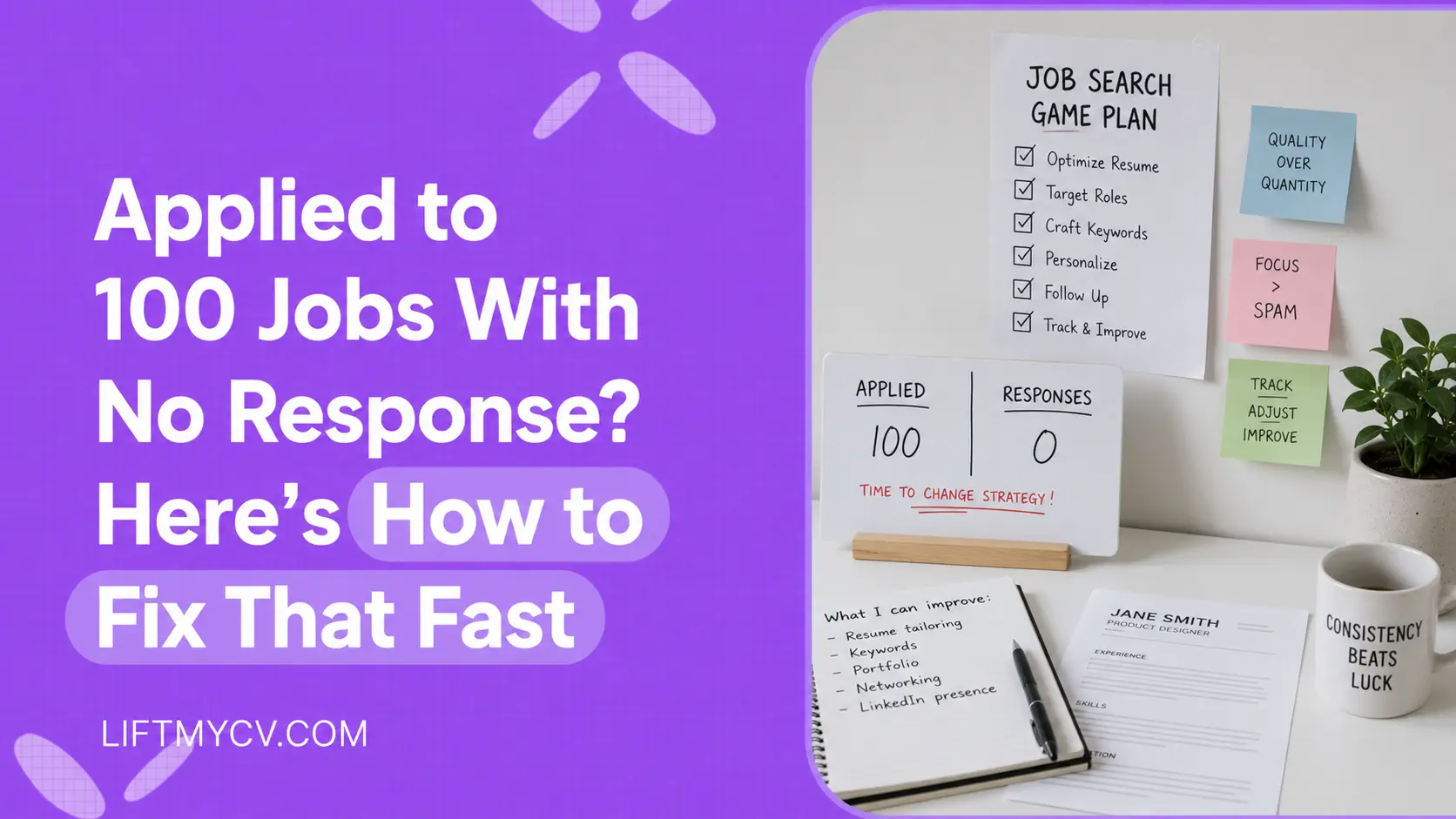
You applied to 100 jobs and heard back from almost none of them. Not a rejection, not an interview, just silence. It is one of the most demoralizing parts of a job search, and it usually means something specific is broken, not that you are unqualified.
The good news is that the causes are fixable, and most of them are about how your application is built and how fast it reaches a human, not about your worth as a candidate. Here is why applying to hundreds of jobs produces no response, and the changes that turn silence into callbacks.
If your inbox has been quiet for weeks, the answer is rarely to send another 100 generic applications. It is to fix what happens between your click and a recruiter’s eyes, then apply faster to the roles that fit.
Why 100 Applications Can Produce Zero Replies
Sending a large volume of applications with no callbacks is a signal, not bad luck. A handful of issues account for most of it: a resume that fails the first automated screen, applications that look identical to everyone else’s, roles that are not a real fit, and submissions that arrive after the shortlist is already full.
Each one is solvable. The mistake most people make is treating no response as a volume problem and applying even harder, when it is almost always a quality and timing problem instead.
Quick Self-Check
- Does your resume repeat the exact job-title wording from each posting?
- Are you applying within a day or two of a job going live?
- Do you meet most of the listed requirements, or only a couple?
- Is every application tailored, or is it the same file every time?
Your Resume Is Probably Getting Filtered First
Most applications never reach a person. They land in an applicant tracking system that scans for how closely your resume matches the posting, then ranks candidates before any recruiter looks. If your wording does not line up with the keywords in the listing, you get filtered out, and the silence that follows feels personal even though a piece of software made the call.
This is why a strong candidate can apply to hundreds of jobs and hear nothing. The resume reads fine to a human but scores poorly against the system. Running your resume through an ATS-friendly format and matching it to each posting is the single highest-impact change you can make.
Did You Know?
The average corporate opening attracts roughly 250 applications. A resume that is not keyword-matched to the posting rarely makes it out of the first automated pass, and common formatting mistakes quietly sink otherwise strong candidates.
Generic Beats Nothing, but Tailored Beats Generic
One resume sent to 100 listings is the fastest path to no response. Recruiters and the systems they rely on are built to spot a generic application, and a generic application reads as low interest even when you are genuinely keen.
Tailoring does not mean rewriting everything. It means mirroring the language of each posting, leading with the experience that role cares about, and cutting the parts that do not apply. Ten tailored applications consistently outperform 100 copies of the same file. The catch is that tailoring by hand is exhausting, which is exactly why most people stop doing it around application number twenty.
Pro Tip
Before you send anything, paste the job description and your resume side by side. If the posting’s core skills do not appear in your resume in similar wording, you are very likely being filtered out. Fix the overlap first, then apply.
You Might Be Applying Too Late
Timing quietly kills strong applications. Candidates who apply in the first 48 hours after a job posts are about 2.5 times more likely to land an interview than those who apply later. By the time a listing has been live a week, the shortlist is often already forming.
If you are checking job boards once every few days and applying in batches, you are arriving late to most of them. Speed is hard to maintain by hand because it means watching listings constantly and applying the moment something fits. This is the part of the search that automation handles far better than a person can.
Turn Silence Into Interviews
LiftmyCV tailors your resume to each posting and applies the moment a matching role goes live, so you stop arriving late and stop getting filtered out. Pay as you go, no subscription required.
The Fix: Fewer Wasted Applications, More Real Matches
The way out is not more volume. It is removing the three leaks that swallow your applications: weak keyword matching, generic resumes, and slow timing. Close those and the same effort starts producing replies.
Here is what that looks like day to day. Instead of firing off 100 identical applications and hoping, you let a system find roles that genuinely match your profile, rewrite your resume around each posting’s keywords, and submit while the listing is fresh. That is the combination recruiters respond to, and it is what an automated job search is built to deliver.
Following up helps too. A short, polite message about a week after applying keeps you visible without being pushy. If you want the wording right, these follow-up email tips cover the timing and tone that actually get a reply.
When It Is Not You
Sometimes the application was always going to lead nowhere. A share of online listings are ghost jobs: postings companies keep open to build a pipeline, satisfy policy, or look like they are growing, with no real intent to hire right now. You can do everything correctly and still hear nothing because the role was never truly open.
You cannot tell ghost jobs apart at a glance, which is one more reason raw volume is a poor strategy. When some fraction of every batch is a dead end, the answer is to apply smarter to real matches, not harder to everything. The scale of ghost listings is bigger than most job seekers realize.
So if you have applied to 100 jobs with no response, run the checklist. Fix the resume so it clears the first screen, tailor each submission, apply while listings are fresh, and let automation carry the volume so your energy goes to the roles you actually want. The silence almost always breaks once those pieces line up.
Frequently Asked Questions
Why am I not getting interviews after applying to so many jobs?
Almost always one of four reasons: your resume is being filtered by an applicant tracking system, your applications are too generic, you are applying to roles you are not a strong fit for, or you are applying too late. Fixing the resume and the timing solves most cases.
Is it normal to apply to 100 jobs and hear nothing?
It is common, and it almost always points to a fixable problem rather than your qualifications. A keyword-matched resume sent quickly to roles you actually fit changes the response rate dramatically compared to 100 generic applications.
How many jobs should I apply to per day?
Quality matters more than a daily quota. If you are not sure what that quota should be, we break down how many jobs to apply to per day. A smaller number of well-matched, tailored applications outperforms a large pile of generic ones. Automation lets you keep volume high without dropping the tailoring that earns replies.
Does following up on applications actually help?
A single polite follow-up about a week after applying can keep you on a recruiter’s radar, especially for roles where you are a close fit. Send one, wait, and if there is still no response, move your energy to fresher listings.

Written by
Ruslan Nazarov is an SEO specialist focused on the careers and job search space. He writes about AI job search, resume optimization, and getting more interviews, drawing on hands-on work growing career and recruitment websites.
LinkedIn ↗
