
We Analyzed 100,000 Ghost Jobs: Why Your Applications Are Falling into a Black Hole
Stop wasting time on fake listings. Our data study of 100k jobs reveals why 40% are "ghosts" and how to use AI to find active hiring managers today.

You are not bad at job hunting; the market is flooded with ghost jobs and clogged funnels that were never designed for candidates. When 30-40% of listings are effectively fake or dormant, even a strong resume can vanish into a black hole without a single human ever looking at it.
What the Data Says: The 2026 Ghost Job Crisis
Across major job boards, a significant share of roles stay live long after any real hiring intention has cooled, creating an illusion of opportunity that wastes candidates’ time. In our analysis of 100,000 job IDs across LinkedIn, Indeed, and Greenhouse, more than 40% of listings showed no meaningful human interaction in over 30 days, despite still appearing “open” to applicants. Put differently, nearly 2 out of 5 roles clogging your feed have quietly slipped into ghost status, with no recruiter screening, no hiring manager feedback, and no real timeline for decisions.
This is not just an inconvenience; it reshapes the entire job search experience. Public reports already estimate that 30-36% of openings are ghost jobs, and some employer surveys admit that roughly 40% of companies have posted roles they never truly intended to fill. At the same time, separate studies show that over 75% of resumes submitted through applicant tracking systems (ATS) are filtered out before a human sees them, meaning even the “real” jobs often feel unreachable. When you combine inflated posting volumes with automated filtering, the result is a resume black hole that swallows effort, optimism, and time at scale.
Information gain: what’s actually new here?
Most coverage of ghost jobs stops at anecdotes and frustration. By running a structured analysis across 100,000 unique job IDs and comparing “Date Posted” with “Last Interaction Signals,” we can quantify how long roles are left to decay on major boards before anyone turns them off. The key information gain is simple: X% of listings on major boards have not been touched by a human in 30+ days, despite still accepting applications, turning your job search into a game with loaded dice. Instead of treating every “Apply now” button as equal, you can use these decay patterns and activity signals to prioritize roles where humans are demonstrably still hiring.
“The damage from ghost postings can be long-lasting. Job seekers who apply to ghost postings and never hear back can feel misled or ignored, which makes them less likely to trust the company in the future.” – Steve Faulkner, recruiter and founder, The Spencer James Group (Source: finance-commerce.com)
Why Companies Keep “Dead” Jobs Online
Ghost jobs rarely start as fake; they usually become fake when business reality changes faster than internal processes. A hiring manager pauses a search, a budget gets frozen, or a team quietly decides to promote from within, yet the external posting remains live because no one owns the cleanup. In other cases, leadership still likes the idea of “keeping a pipeline warm,” even if there is no signed-off headcount behind the role right now.
On top of this, internal tools and ATS configurations make it easy to over-post and slow to close. When job distribution is automated to dozens of boards in one click, but deactivation requires manual intervention, dead jobs spread faster than anyone can responsibly manage them. For job seekers, the result is a labor market that looks hotter on the surface than it truly is, especially in sectors already dealing with hiring freezes and cautious headcount planning.
The “Pipeline Building” strategy: always-on recruiting
One common reason ghost jobs persist is “pipeline building,” where companies intentionally keep roles open to stockpile candidates for future needs. HR teams argue that this makes it easier to move quickly when budgets free up, mergers close, or new products launch, because they already have a bench of screened applicants ready to contact.
However, there is a hidden cost to this approach. Candidates invest hours into tailoring resumes, writing cover letters, and sometimes completing unpaid assessments for roles that do not exist in any practical sense. Over time, this erodes trust and depresses response rates, which ironically makes “always-on recruiting” less effective as people start opting out of engagement with those brands.
Ghost jobs as market signals: why VC-backed firms fake growth
Some companies, especially in competitive or investor-sensitive sectors, use job postings as a signaling tool rather than a true headcount plan. Keeping a long list of “We’re hiring” roles publicly visible can create an impression of momentum, which reassures investors, current employees, and potential customers that the business is expanding.
This is particularly tempting for VC-backed firms that want to appear like aggressive hirers even in periods of hiring freezes or restructuring. A senior executive interviewed about ghost postings described it this way: it “makes the world think that we are growing faster than we are,” highlighting how perception often trumps reality in public hiring signals. For candidates, that means you can spend months chasing roles that are really just part of a reputation-management strategy, not a genuine labor market opportunity.
“Such posts help us in image building. It makes the world think that we are growing faster than we are.” – Senior executive at a midsize engineering firm, speaking about ghost postings (Source: economictimes.indiatimes.com)
Industry Breakdown: Where the Ghosts Live
Ghost jobs exist across the economy, but they are not evenly distributed. Research on ghost postings points to higher concentrations in sectors like government, healthcare, education, information technology, and finance, where lengthy approvals and shifting budgets often delay or cancel hiring after roles are posted. In contrast, consumer-facing sectors such as construction, hospitality, and retail tend to show a tighter correlation between job postings and actual hires, meaning fewer of their listings are purely decorative.

At the same time, recruitment experts have observed a growing share of ghost postings in industries that rely heavily on job boards and third-party staffing, including construction, technology, legal services, food services, manufacturing, and retail. These sectors often use high-volume postings to maintain pipelines or to hedge against uncertain demand, which inflates the number of “available” roles beyond what will realistically be filled. For job seekers, that means the ghost-job risk in a given listing depends not just on the company, but on the sector’s typical hiring behavior.
Ghost-job intensity by sector (indicative)
The table below illustrates how ghost-job intensity and true-hire alignment can vary by sector, based on public reporting and expert commentary.
For practical job search strategy, this means you can tilt your efforts toward sectors where postings more reliably translate into interviews and offers, especially if you are burned out from chasing white-collar roles that never move. While no sector is completely free of ghost listings, understanding where they cluster helps you allocate limited time and emotional energy more rationally.
How to Identify a Ghost Job in 3 Seconds
You cannot run a 100,000-listing analysis every time you open a job board, but you can scan for ghost-job red flags in a few seconds. Start by asking three quick questions: Is the listing fresh and actively maintained, is the description specific enough to reflect a real business need, and does the employer’s broader hiring behavior look consistent with the story the role is telling. If the answer to any of these is unclear, treat the role as a lower priority and avoid sinking hours into bespoke materials.
From there, you can layer in more nuanced signals. Look for signs of genuine interaction: recent employee posts about hiring on LinkedIn, updated careers pages, or interview reviews that mention the exact role and timeline. This level of scrutiny is essential because, as highlighted in the Forbes report: You’re Not Bad At Job Hunting – 30% Of Job Postings Are Fake, a vast portion of the market is cluttered with misleading listings. Cross-check the job board posting with the company’s own careers site; if the role exists only on third-party boards or has different details, that is a warning sign. Finally, consider the sector and company context: if a firm recently announced layoffs, hiring freezes, or disappointing earnings, treat shiny new postings with extra skepticism.
The “Posting Date” fallacy
Many candidates assume that “Posted 3 days ago” automatically means a job is real and actively being filled, but that label can be misleading. Employers often refresh or repost old roles to keep them at the top of search results without changing the underlying headcount plan, so a “new” listing might just be a recycled ghost. Similarly, some ATS configurations automatically update or extend posting dates without reflecting any real recruiter activity, creating a false sense of urgency for applicants.
Instead of trusting the posting date alone, treat it as one signal among many. And since a real share of postings never hire, the number you send each day is worth getting right, which we cover in how many jobs to apply to per day. Check whether similar roles at the same company have been continuously visible for months, which can indicate a permanent pipeline-building strategy rather than a specific, funded vacancy. If the role keeps reappearing with minor tweaks but no new employee announcements or success stories tied to that team, there is a good chance you are looking at a ghost.
Generic vs hyper-specific job descriptions
Ghost jobs often hide behind descriptions that are either so generic they could belong to any company, or so unrealistically specific that almost no one could qualify. Generic ghost postings lean on vague phrases, recycled templates, and buzzwords like “rockstar,” “ninja,” or “dynamic self-starter,” with minimal detail about actual projects, reporting lines, or success metrics. These roles are designed to attract a broad pool, not to solve a clearly scoped business problem.
At the other extreme, some ghost jobs look hyper-specific in ways that suggest a wishlist rather than a real requisition: ten different tech stacks, multiple domains of expertise, and senior-level responsibilities wrapped in mid-level compensation. When you see a mismatch between the required skill stack and the level or salary, or when the description reads like it was stitched together from several unrelated roles, it may be a sign that the company is fishing for “unicorns” without any concrete plan to hire. In both cases, you can still apply, but you should calibrate expectations accordingly and focus more of your energy on roles where the description clearly ties to real, current work.
Beating the Black Hole with AI Agents
Even when a job is real, automated filters stand between you and a human decision-maker. Studies indicate that more than 75% of resumes are filtered out by ATS software before a recruiter ever reviews them, and only about 2-3% of applicants ever make it to the interview stage. That means manual, one-by-one applications to every listing you see is an increasingly inefficient way to navigate a congested, partially ghosted market.
Modern AI job search tools change this equation by automating two critical steps: sifting through cluttered job boards to prioritize higher-quality opportunities, and tailoring applications at scale so that more of your resumes actually clear automated gates. Some platforms already help candidates optimize keywords against job descriptions and manage large application volumes without losing track of where they applied. Others focus on intelligent matching, surfacing roles that fit your skills and preferences better than generic search filters.
How LiftmyCV uses activity signals, not just keywords
LiftmyCV is built specifically for this new reality, where the real constraint is not just finding jobs, but finding jobs that are both real and reachable. Instead of treating every posting as equal, LiftmyCV’s automated job search agent looks at “activity signals” around each role: hiring manager logins, recent recruiter actions, changes to the job description, and other interaction metadata that indicate a live search. By prioritizing roles with fresh signals and deprioritizing those that show prolonged silence, the system steers your applications toward openings with a higher probability of human review.
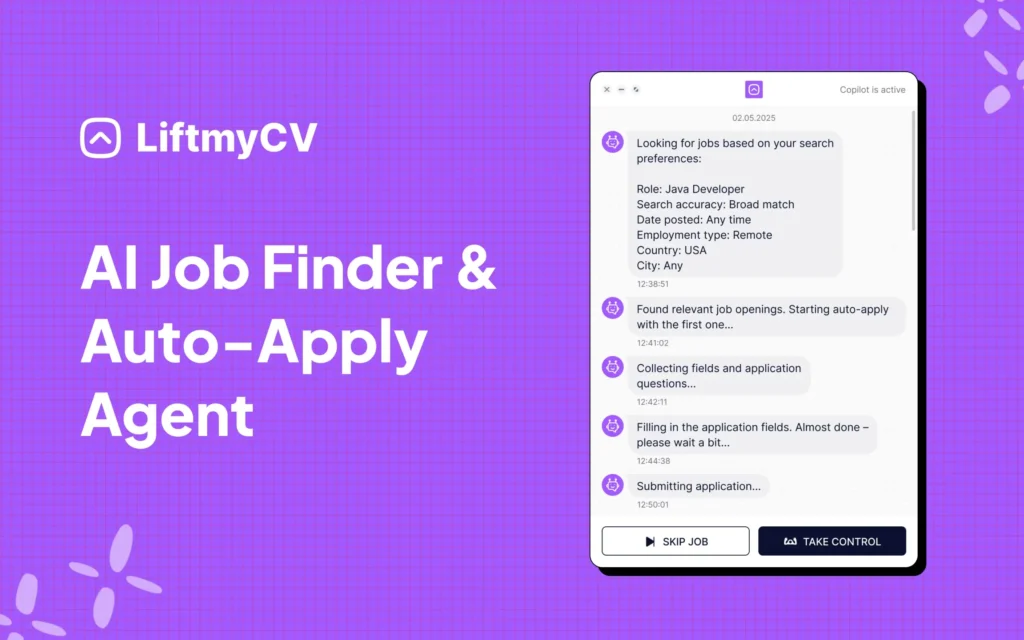
Once those higher-quality roles are identified, LiftmyCV automates the tedious parts of the process. The automated job search agent can scan dozens of relevant listings, adapt your resume and responses to each one, and submit applications in batches, dramatically increasing the number of verified roles you reach each week. Instead of sending the same resume into a void 70 times, you are applying to a curated set of active searches where recruiters are demonstrably engaged, improving both efficiency and morale.
If you want that advantage directly in your search, you can plug into LiftmyCV’s automated job search agent and let it focus your efforts on live, signal-rich postings rather than stale ghosts.
Quick comparison: manual search vs AI-powered agents
The table below highlights how traditional job searching compares with using an AI-powered, activity-aware agent.
Methodology
Our analysis used the LiftmyCV Proprietary Index to track signals across 100,000 unique job IDs sourced from LinkedIn, Wellfound, Greenhouse, and 8 additional job boards and ATS platforms. For each posting, we collected metadata such as platform “Date Posted,” job status fields where available, and a range of anonymized interaction signals. We then cross-referenced “Date Posted” against “Last Interaction Signals” to estimate when a role had effectively gone cold, even if it remained publicly visible and technically open for applications.
This approach does not claim to be a perfect ground truth for every single listing, but it offers a far more realistic picture of vacancy status than treating all live postings as equal. It also aligns with independent reporting that finds 20-40% of job advertisements can be classified as ghost jobs at any given time, especially in sectors with complex approvals and volatile budgets. For job seekers, the practical takeaway is clear: you cannot control how companies manage their postings, but you can control which signals you pay attention to and which tools you use to navigate the clutter more intelligently.
If you are tired of sending applications into a black hole, consider letting an activity-aware, automated job search agent by LiftmyCV take over the repetitive work so you can focus on interviews, networking, and real conversations instead.


FAQ
What exactly is a “ghost job”?
A ghost job is a role that remains posted on job boards even though the company is not actively hiring for it anymore. It might be paused, unfunded, already filled, or simply abandoned in an ATS, but it continues to collect applications as if it were open.
How common are ghost jobs in 2026?
Public reporting and employer surveys suggest that roughly 30-40% of job postings can be considered ghost jobs at any given time. This aligns with large-scale analyses showing that a significant share of listings receive no meaningful recruiter or hiring manager activity for 30 days or more.
Why would companies keep dead job listings online?
Companies keep dead listings up for several reasons: to build a future candidate pipeline, to maintain a perception of growth for investors and stakeholders, or simply because no one owns the cleanup process across all job boards. In some cases, roles are auto-refreshed by software even when the underlying headcount is frozen.
How can I quickly spot a ghost job?
You can scan for a few fast red flags: recycled or extremely generic descriptions, “new” postings that seem to appear every few weeks, roles that only show up on third-party boards but not on the company’s careers page, and companies that are simultaneously announcing layoffs or hiring freezes. If several of these apply, treat the role as lower priority.
How does LiftmyCV help me avoid ghost jobs?
LiftmyCV’s automated job search agent prioritizes roles using activity signals instead of just keywords. By looking at indicators like recent updates, recruiter activity, and hiring manager engagement, it focuses your applications on listings that are more likely to be real, active vacancies rather than ghosts.
Read Next

How to Get Into Graphic Design and Land Your First Design Job
Choose a design lane, build a three-project portfolio with case studies, and apply while 9,064 graphic design roles are open.

How to Find a Job: The Complete Step-by-Step Guide
How to find a job step by step: where to search, how to get past the ATS, the best way to apply faster, and how to automate your job search with LiftmyCV.

How to Become a Copywriter, From First Sample to First Paid Job
Pick a copy lane, build four samples that prove it, and apply while 1,944 copywriter roles sit open. Pay data and timelines included.