
How to Become a Copywriter, From First Sample to First Paid Job
Pick a copy lane, build four samples that prove it, and apply while 1,944 copywriter roles sit open. Pay data and timelines included.
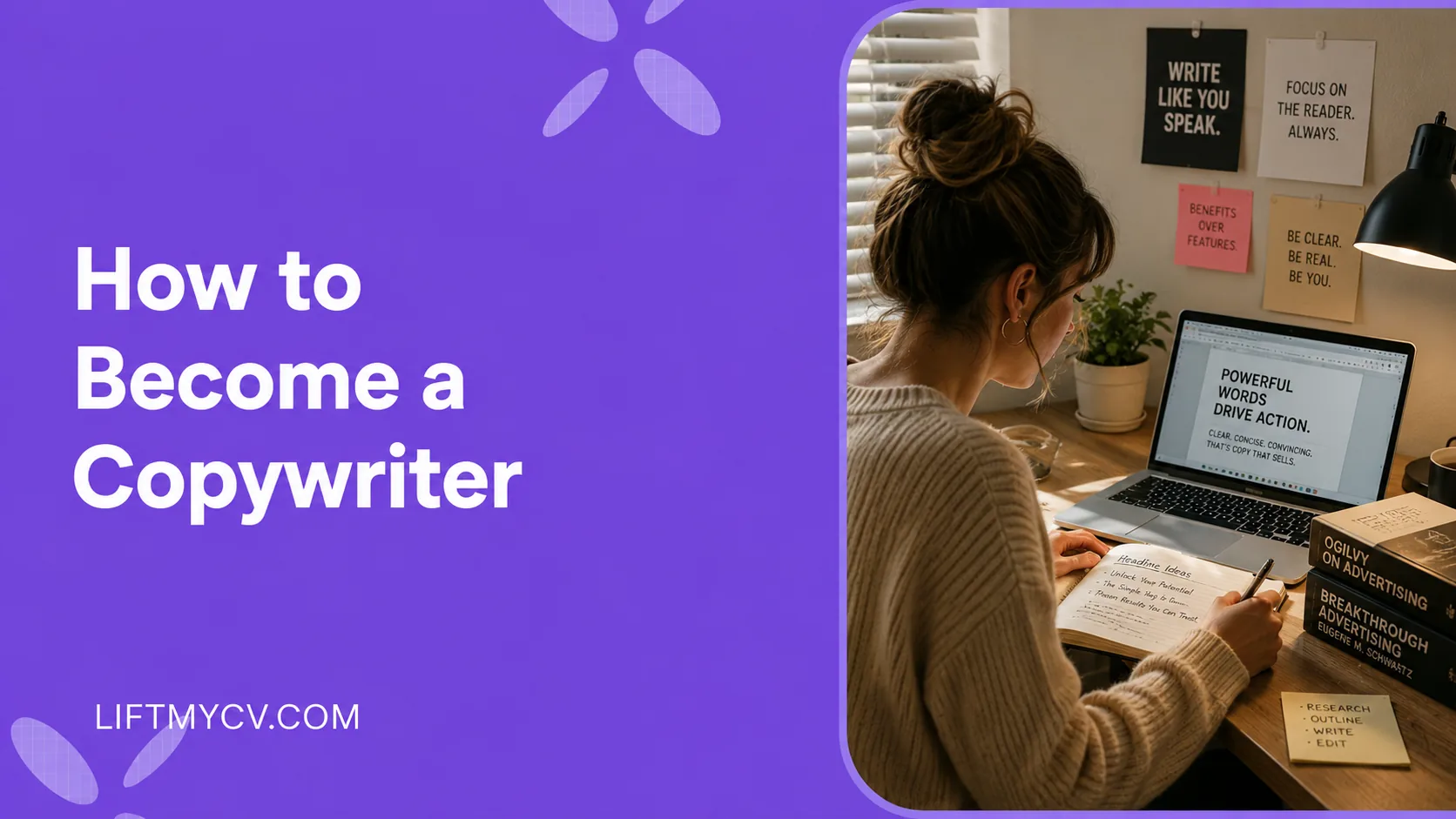
1,944 copywriter jobs sat open on the LiftmyCV feed in the last week of July 2026. Almost none named a copywriting degree as a hard requirement. Nearly all wanted a portfolio link.
That gap answers most of the question. To become a copywriter you pick one commercial lane, build four to six samples that prove you can write inside it, then apply at a volume that matches how fast creative teams fill roles. Credentials sit below evidence in every screening order this market runs on.
Describing that route takes a paragraph. Walking it takes months.
Copywriter hiring, July 2026 (LiftmyCV job feed)
- 1,944 active copywriter openings, refreshed daily.
- Median salary $71,250 across the 505 postings that publish pay.
- Entry-level postings sit at a $59,000 median, senior postings at $96,175.
- 428 of the tracked roles are entry level, 816 mid, 700 senior.
What a Copywriter Is Paid to Do
A copywriter writes words that make someone act: buy, subscribe, book, click, renew, or stay. Content writing informs and earns attention over time. Copywriting has to move a specific person toward a specific action, usually on a page or in an inbox where the business is counting.
Hiring managers hold that line hard. A job description asking for landing pages, ad variations, subject lines, and value propositions is buying persuasion. One asking for blog posts, guides, and newsletters is buying attention. Same craft underneath, different scoreboard, and the samples you send should match whichever scoreboard the posting uses.
Which is why the first move in copywriting is a choice, not a course.
Pick a Copy Lane Before You Write a Word
Generalist portfolios lose to specialist ones at the screening stage. A creative director hiring for paid social opens your link expecting hooks and ad variations, and a stack of polished blog intros reads as a miss even when the writing is good. The lanes below cover most of what the 1,944 open roles are asking for.
| Copy lane | What the copy has to do | Sample that proves it | Who hires for it |
|---|---|---|---|
| Direct response | Sell inside one scroll | Three ad variations for one product plus the reasoning behind each | Ecommerce brands, subscription apps, performance agencies |
| Brand copy | Set voice, message, and campaign lines | A homepage hero, a campaign line, and a short voice guide | In-house creative teams, agencies |
| Email and lifecycle | Move people through a sequence | A four-email welcome flow with subject line variants | Retail, SaaS, consumer goods |
| SEO copy | Rank and convert on the same page | A category or product page with the search intent written out | Publishers, ecommerce, marketing agencies |
| Product and UX copy | Explain and remove friction | Onboarding screens, empty states, error messages | SaaS and app teams |
| Social and short form | Stop the scroll | Ten hooks for one offer and two short video scripts | Consumer brands, creator-led companies |
Openings on the feed carry exactly these labels: direct response copywriter, email copywriter, SEO copywriter, social media copywriter, campaign copywriter, promotions writer. Pick the one closest to what you already read, watch, and buy. Taste in a category is a real advantage, and it shortens the research time on every brief you get.
How to Become a Copywriter Without a Degree
Most copywriter postings ask for a bachelor’s degree in English, journalism, communications, marketing, “or equivalent experience.” That last clause carries more weight in copywriting than in almost any other white-collar role, because the work product is visible. A recruiter can read your samples in three minutes and know what you can do. No transcript compresses that well.
What replaces the degree is proof at the same level of finish as paid work:
- Finished pieces that look client-ready, not drafts with placeholder headlines.
- A short note on each sample naming the audience, the offer, and the goal.
- One example of revision, showing an early version and what changed after feedback.
- Any live work with a URL, even a friend’s small business page you rewrote.
People who break into copywriting without a degree usually arrive from a job that already involved persuasion. Sales, customer support, teaching, retail, recruiting, hospitality. Those roles teach you objections, and objection-handling is half of conversion copywriting. Say so in the application instead of apologizing for the background.
How to Start as a Copywriter With No Experience
Chicken-and-egg is less of a trap here than in most fields, because copywriting lets you manufacture credible evidence before anyone hires you. Spec work counts, as long as you label it as spec.
Write for products that already exist
Choose four real products you understand. Write the piece each one is missing: an ad set for a supplement brand running weak creative, a welcome sequence for an app that sends nothing after signup, a product page for a small maker with beautiful photos and flat copy. Real constraints beat invented ones, and the reader can check your work against a real market.
Show the reasoning under every line
Under each sample, write three sentences: who this is for, what it has to achieve, and why you made the central choice you made. Creative directors have been saying this to applicants for twenty years and it still sorts the top of the pile from the middle. A pretty headline with no reasoning behind it looks like luck. A decent headline with clear reasoning behind it looks like a hire.
Four to six of these, arranged so the strongest sits first, is a working copywriting portfolio. It is enough to apply. It is also enough for a small freelance client, which turns spec work into paid work and paid work into a stronger portfolio, which is how most careers here actually compound from nothing into a salary.
What Copywriters Earn, by Level
Pay data below comes from the 505 copywriter postings on the LiftmyCV feed that publish a salary, as of July 2026.
| Level | 25th percentile | Median | 75th percentile |
|---|---|---|---|
| All copywriter roles | $60,062 | $71,250 | $95,000 |
| Entry level | $35,880 | $59,000 | $69,320 |
| Mid level | $59,750 | $70,000 | $80,000 |
| Senior level | $88,250 | $96,175 | $117,500 |
Moving from mid to senior is where lane choice pays off. Senior postings are not asking for more words per week. They ask for concept ownership, stakeholder judgment, and someone who can defend a messaging decision in a room that also holds marketing, legal, and product.
How Long It Takes to Break Into Copywriting
Four to eight weeks of evenings gets most people a first portfolio. Landing paid work after that, freelance or salaried, runs another two to six months, and the spread depends far more on application volume than on talent.
Anyone promising a six-figure copywriting income in thirty days is selling a course.
For a career changer starting from zero, plan on six to twelve months before a steady seat, with freelance projects filling the middle. Coming from a marketing-adjacent job cuts that roughly in half, because half your samples already sit inside old work: the launch email you drafted for your last employer, the product description you rewrote when sales complained, the internal deck that got approved because your framing was clearer than the previous version. Ask for permission where the work belongs to someone else, redact client names where you have to, and put it in the portfolio. Junior in-house roles then move quickly, since a hiring team can hand you a live brief and see real output by the end of week one, which is a much lower risk for them than betting on a stranger with nothing published.
How to Get a Copywriter Job Once Your Samples Hold Up
Applications fail at three predictable places, and all three are fixable.
The first is the portfolio link buried at the bottom of page two. Put it in the header of your resume next to your email, where a recruiter scanning for 40 seconds will land on it. The second is a generic resume sent to every posting: a copywriter who cannot tailor 200 words for a hiring manager will not be trusted to tailor 2,000 for a customer. The third is volume. Creative roles close fast, often inside two weeks, so the writer who applies to eight relevant openings a week beats the one who polishes a single application for a month.
Match the sample order to each posting. Paid social role, lead with hooks. Ecommerce brand, lead with product pages and email. Then pull your targets from a live source rather than a stale search: the current copywriter openings tracked by LiftmyCV are refreshed daily across job boards and ATS platforms, with salary bands and work type attached to each listing.
Your samples are ready. Your calendar is not.
Tailoring a resume for every copywriter opening takes an evening. An AI agent does it per posting and submits while you keep writing.


FAQ
How do I become a copywriter with no experience?
Pick one copy lane, then write four spec pieces for real products in that lane and publish them with a short note on audience, offer, and goal. That portfolio is what employers screen on. Roles titled junior copywriter, marketing assistant, or content associate are the usual first seats, and small freelance projects fill the gap while you apply.
Can you become a copywriter without a degree?
Yes. Most postings list a degree with an “or equivalent experience” clause, and copywriting is judged on samples you can show in minutes.
How long does it take to become a copywriter?
Four to eight weeks to build a first portfolio, then two to six months of applying for a first paid role. Career changers starting from zero usually reach a steady seat inside a year, faster if their previous job involved sales, support, or marketing.
Do copywriter jobs require a portfolio?
In practice yes, including entry-level roles. Postings across agencies, in-house brands, and ecommerce teams ask for a link, and a strong portfolio outweighs a certificate list. Four to six pieces is enough to start applying.
How much do copywriters make?
The median across copywriter postings tracked by LiftmyCV in July 2026 is $71,250, with entry-level medians near $59,000 and senior medians near $96,175. Direct response and lifecycle email specialists tend to price above generalists because their work is measured directly in revenue.
Is copywriting worth getting into now that AI writes copy?
The roles that shifted are the ones that were volume-driven: bulk product descriptions, thin SEO filler, first-draft ad variations. Postings on the feed now ask writers to direct AI output rather than compete with it, and they pay for the judgment that decides which of forty generated headlines is the one worth spending media budget on. Strategy, audience insight, and editing sit outside what a model does unattended, and those are the things a portfolio should demonstrate.
Read Next

How to Get Into Graphic Design and Land Your First Design Job
Choose a design lane, build a three-project portfolio with case studies, and apply while 9,064 graphic design roles are open.
How to Find a Job: The Complete Step-by-Step Guide
How to find a job step by step: where to search, how to get past the ATS, the best way to apply faster, and how to automate your job search with LiftmyCV.
How to Become a Case Manager: Entry Routes, Licenses, and Jobs
What you need to become a case manager, how to get in without a degree or experience, which certifications matter, and how to land your first job.