
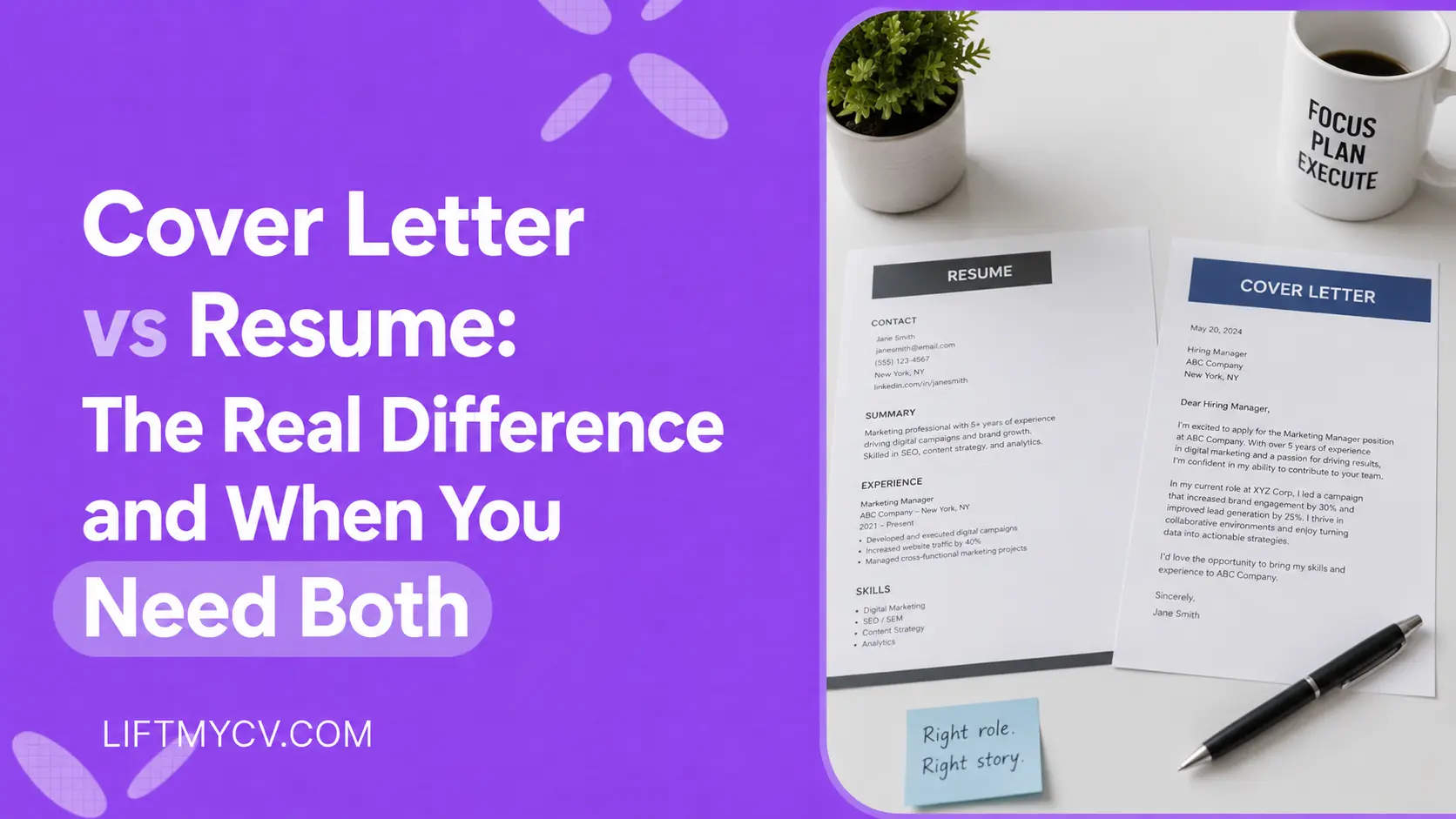
You sit down to apply for a job and two documents stare back at you: a resume and a cover letter. They feel similar enough that plenty of people copy half of one into the other, then wonder why they never hear back. The truth is they do different jobs, and treating them as interchangeable weakens both.
Understanding cover letter vs resume starts with one idea. A resume proves you can do the work. A cover letter explains why you want this specific role and how your background connects to it. This guide breaks down the differences in purpose, format, content, and tone, then shows how to make both work together without spending an hour on every application.
If writing and tailoring both for every posting already sounds exhausting, that is the real problem worth solving, and you can generate a job-specific cover letter in seconds instead of from scratch.
Cover Letter vs Resume: The Core Difference
A resume is a structured summary of your professional history. It lists your experience, skills, education, and measurable results in a scannable format a recruiter can read in seconds. It looks backward at what you have already done.
A cover letter is a short, written argument for one specific job. It is conversational, written in full sentences, and focused on the present and future: why this role, why this company, and how your background solves the problem they are hiring for. The resume shows the facts. The cover letter gives them meaning.
Resume vs Cover Letter, Side by Side
The fastest way to see the difference is to put the two documents next to each other. Each one has a distinct format, length, and purpose.
| Feature | Resume | Cover Letter |
|---|---|---|
| Purpose | Proves you meet the requirements | Explains why you fit this role |
| Format | Sections and bullet points | Full paragraphs |
| Length | One to two pages | One page, three to four short paragraphs |
| Focus | Broad career history | One specific job |
| Tone | Concise and professional | Conversational, shows personality |
| Time frame | Past achievements | Present and future fit |
Notice that they never overlap in job. When a cover letter simply restates the bullet points from a resume, it adds nothing and a recruiter stops reading. The two only work when each does the part the other cannot.
What Goes on a Resume
A resume is built for speed and for software. Most applications pass through an applicant tracking system that scans for keywords before a recruiter ever opens the file, so structure and wording decide whether you make the shortlist.
Keep it to clean sections: a short summary, work experience with measurable results, skills, and education. Use bullet points, not paragraphs. Mirror the language of the job posting so the system scores you as a match. If formatting is working against you, an ATS-friendly resume layout is the single biggest fix, because a strong candidate with a poorly formatted file still gets filtered out.
Pro Tip
Skip tables, columns, and graphics in your resume. They look polished to you but can scramble inside an applicant tracking system, which reads your file as plain text. A clean single-column layout passes the screen far more reliably.
What Goes in a Cover Letter
A cover letter is where you sound like a person. Open with why this specific role caught your attention, connect one or two of your achievements directly to what the company needs, and close with a clear, confident next step. Three to four short paragraphs is plenty.
The mistake most people make is writing one generic letter and reusing it everywhere. A cover letter only works when it names the role, reflects the company, and speaks to that posting. That is also why writing them by hand is slow, and why most applicants quietly stop after the first dozen. If you want a model to work from, these cover letter examples show the structure that gets read.
Stop Choosing Between Speed and Quality
LiftmyCV builds an ATS-friendly resume and a job-specific cover letter for every application, tailored to each posting in seconds. Pay as you go, no subscription required.
Do You Need Both?
When a job asks for both, send both. The resume gets you past the initial screen, and the cover letter is often what tips a borderline candidate into the interview pile. Skipping it when it is requested reads as low interest.
When a cover letter is optional, it still helps for roles you genuinely want, especially when you are changing careers or your resume needs context a list of bullet points cannot give. For high-volume applying to standard roles, a strong resume carries most of the weight, and a tailored letter is the edge on the ones that matter. The two are partners, not substitutes.
Did You Know?
A cover letter that is tailored to the posting can be the deciding factor between two equally qualified candidates. Pairing it with an ATS-ready resume is what turns a strong application into an interview.
The Hard Part: Tailoring Both to Every Job
Here is what the advice articles skip. Writing one good resume and one good cover letter is manageable. Tailoring both to every single posting, matching keywords on the resume and rewriting the letter for each company, is where the effort collapses. Most people give up around application number twenty and start sending generic versions, which is exactly when the callbacks dry up.
This is the part worth automating. Instead of rewriting both documents by hand for every role, you can have the resume rebuilt around each posting’s keywords and a fresh, job-specific cover letter generated for every application. The AI reads what you have already written and adapts it, so each submission stays tailored without costing you an hour. If you have leaned on tools before, even a basic AI cover letter workflow shows how much time this saves once the writing is no longer manual.
Cover letter and resume are not rivals. One proves you can do the job and the other explains why you want it, and together they make a complete case. Get both tailored to each role and you stop blending into the pile of generic applications that never get a reply.
Frequently Asked Questions
What is the main difference between a cover letter and a resume?
A resume is a structured list of your experience, skills, and achievements that proves you meet the requirements. A cover letter is a short written argument, in full paragraphs, explaining why you fit one specific role. The resume shows the facts; the cover letter gives them context.
Do you need both a cover letter and a resume?
Send both whenever a job asks for them. The resume gets you through the initial screen, and a tailored cover letter often tips a close call toward an interview. When the cover letter is optional, it still helps for roles you really want or when you are changing careers.
Should a cover letter repeat the resume?
No. If your cover letter just restates your resume bullet points, it adds nothing and recruiters stop reading. Use it to connect your background to the specific role and to show context the resume cannot, like why you want this job at this company.
Which is more important, the cover letter or the resume?
The resume carries more weight because it is what gets scanned and screened first. But for roles where candidates are closely matched, a tailored cover letter is often the deciding factor. The strongest applications treat both as one connected package.

Written by
Ruslan Nazarov is an SEO specialist focused on the careers and job search space. He writes about AI job search, resume optimization, and getting more interviews, drawing on hands-on work growing career and recruitment websites.
LinkedIn ↗
