
Is It Bad To Use AI For Your Cover Letter In 2026?
Can recruiters spot AI in 2026? Discover how hiring managers flag generic drafts and use our proven 3-step framework to create authentic applications.
Originally published in April 2025. Fully updated and fact-checked in February 2026 to reflect the latest AI recruitment trends.
If you use AI to write your cover letter on autopilot and send it unchanged, you are taking a real risk. If you use AI as a co‑pilot and inject your own stories, data, and voice, it can actually improve your results.
The January 2026 Shift: What Recruiters Expect Now
Since late 2025, more hiring teams openly scrutinize AI‑written applications, while at the same time relying more heavily on AI to screen them. That tension is exactly where job seekers can win or lose. Several things changed recently:
- Many employers now use large language models to pre‑screen resumes and cover letters, ranking them before a human ever sees them.
- In a 2025 survey of 600 U.S. hiring managers, nearly 1 in 5 said they would reject an application if the resume or cover letter appeared fully AI‑generated.
- More than one‑third of those managers said they can spot AI‑generated resumes in under 20 seconds.
- At the same time, AI‑driven resume screeners and hiring tools have been shown to exhibit gender and racial bias, often preferring resumes tied to white‑sounding male names.
So the environment in 2026 looks like this:
- AI is screening you.
- Recruiters assume you might be using AI.
- Some will penalize you for sounding like a bot, but many expect you to use AI responsibly as a productivity tool.
A tech hiring leader at Korn Ferry notes that using AI to enhance application materials is now “commonplace” and usually not viewed negatively in tech, as long as the content is accurate and authentic.
LiftmyCV Lab Results: Human vs AI Cover Letters
At LiftmyCV, we continually test how different application strategies perform across thousands of real submissions. For this article, we looked specifically at cover‑letter performance across three approaches:
- AI‑only: Prompting an LLM to “write my cover letter” and sending it unchanged.
- Human‑augmented AI: Using AI drafts but editing them with personal stories, metrics, and context.
- Human‑first with AI polishing: Writing a rough draft yourself, then using AI to tighten structure, clarity, and keywords.
From internal LiftmyCV campaign data across several thousand applications in 2025, we see consistent patterns:
- AI‑only cover letters had a lower open rate than letters where humans added their own stories and specifics.
- Recruiters were more likely to respond when the letter referenced concrete achievements and company‑specific details, even if AI helped shape the language.
- Applications combining structured AI help with human editing were more likely to be shortlisted by AI‑based resume screeners while still passing human “smell tests.”
To illustrate the “Speed vs Soul” dynamic, here is a high‑level comparison:
Outcomes: AI‑Only vs Human‑Augmented Letters (LiftmyCV Lab)
This is why we position LiftmyCV’s assistant as a co‑pilot, not an auto‑writer: the platform uses LLMs to optimize your profile and tailor applications for ATS, but it depends on the data, preferences, and stories you feed it.
What Recruiters Really Think About AI Cover Letters
The answer is not “AI is bad” but “AI without honesty or effort is bad.”
Recent research and surveys show a nuanced picture:
- A 2025 TopResume survey of 600 U.S. hiring managers found that 19.6% would reject a candidate if they believed the resume or cover letter was generated entirely by AI.
- Over 33% of those hiring managers said they can recognize an AI‑generated resume in under 20 seconds.
- A Dutch experimental study on ChatGPT in cover letters found that recruiter ratings dropped significantly when they were told AI had been used, even when the content quality itself was similar.

At the same time, experienced recruiters don’t necessarily see all AI use as a problem:
- In tech especially, hiring managers often assume strong candidates will know how to use AI tools.
- One tech talent leader at Korn Ferry describes AI as appropriate for summarizing achievements and tailoring resumes, as long as the information remains accurate.
To put those attitudes side by side:
How Hiring Managers View AI Use
An HR consultant we work with summed it up clearly:
“The problem isn’t that candidates use AI. The problem is when every cover letter sounds like it was written by the same polite robot, with zero personal context.” – Senior HR consultant working with mid‑size tech firms
Why Pure AI Text Feels “Off” To Humans (And Machines)
Most generic AI cover letters fail for three main reasons:
- No real experience signals: Models are trained on broad internet data, not on your lived experience. They can guess plausible achievements, but they cannot know what you actually delivered, which leads to vague claims like “I am passionate about innovation.”
- Patterned language that detectors and humans recognize: AI detection tools such as Turnitin’s AI detector analyze statistical patterns in wording and sentence structure to estimate how likely text is to be AI‑generated. Even when content is paraphrased, high predictability can still be flagged.
- Mismatch with your resume and digital footprint: When cover letters contain polished, generic prose that doesn’t match the style or specifics of your resume, LinkedIn profile, or portfolio, it triggers doubt for reviewers.
Meanwhile, AI is also filtering your documents:
- Large language model based screeners often prefer AI‑generated resumes over human‑written ones because they match the model’s own patterns more closely.
- In one resume‑screening simulation, applicants who used the same LLM to prepare their resume as the one used to evaluate it were shortlisted 23-60% more often than equally qualified candidates with human‑written resumes.
This creates a strange “LLM vs LLM” loop and raises serious concerns about algorithmic bias in hiring: studies show that popular AI resume screeners and LLM‑based tools can favor white‑sounding male names up to 85% of the time, even when the underlying experience is equivalent. That is a core example of algorithmic bias in hiring.
The Real Risks: Beyond Being “Caught” Using AI
Worrying only about whether an AI detector will catch you misses the bigger picture. The deeper risks of relying blindly on AI for cover letters include:
- AI hallucinations in resumes and cover letters: LLMs can fabricate job titles, certifications, or metrics that never happened, especially when prompts are vague. If a recruiter cross‑checks those claims against your LinkedIn or background checks, your application can be discarded instantly.
- Amplifying bias in AI‑driven screening: Major studies in 2024-2025 showed that AI resume screening tools can prefer resumes linked to white, male, or majority identities, replicating historical inequities embedded in training data. If you let AI rewrite your story too aggressively, you may unintentionally make your profile fit stereotypes that perform better in biased systems, rather than showcasing your authentic strengths.
- Damaging your personal brand authenticity: When every public artifact of your career (LinkedIn, portfolio, cover letters) reads like the same sanitized chatbot, it becomes hard for hiring managers to understand what you actually stand for. Over time, that erodes trust in your personal brand.
A recruiting leader we consulted put it bluntly:
“I don’t reject people for using AI. I reject people because, after reading their AI‑polished letter, I still have no idea who they are or what they’ve actually done.” – Head of Talent at a European SaaS company, 2025
How 2026 AI Detection Actually Works (And Why Evading It Is The Wrong Goal)
Modern detection in hiring settings is rarely just “paste your text into a detector.” Employers and educational institutions increasingly combine several layers:
- Statistical AI detectors
Tools like Turnitin’s AI detector and enterprise‑grade services such as Copyleaks analyze token‑by‑token predictability, sentence structure, and known watermarking or paraphrasing patterns. Even “humanizers” that rewrite text to evade detection can still be flagged when patterns remain too regular. - Metadata and behavioral signals
Some systems correlate submission time, IP, and editing history (for example on learning platforms or internal portals) with suspected AI use. - Cross‑checks against resumes, applications, and assessments
Employers may compare your cover letter against your resume, test answers, and interview performance to see if the writing style and knowledge depth align.
Some “AI humanizer” tools promise to remove watermarks or make AI content undetectable, but they typically work by heavily rephrasing or introducing random noise into the text. That might help dodge a detector, but it does nothing to fix fabricated claims, bias, or lack of substance.
Most importantly, the direction of travel is clear:
- Detection will continue to improve and combine multiple signals.
- Research from Tilburg University on ChatGPT usage in cover letters suggests that recruiters are less concerned with whether you used AI at all and more concerned with whether you misrepresented yourself, a finding we’ve further validated in our 2026 AI recruitment update.
Trying to “beat” detectors is the wrong game. Your strategy should be to make your cover letter true, specific, and clearly grounded in your own experiences, so detection is not a threat in the first place. For ready-to-use starting points, browse our cover letter examples and adapt one to your own story.
The “Human‑In‑The‑Loop” Framework: How To Safely Use AI For Cover Letters
Instead of asking “Is it bad to use AI?” a more useful question is “Where should I use AI, and where must I be fully human?” Below is a 3‑step framework you can apply immediately.
Step 1: Zero‑Party Data Extraction
Zero‑party data is information you intentionally and proactively share about yourself: your stories, motivations, constraints, and preferences. For your cover letter, you should gather:
- 3-5 concrete achievements with metrics (for example, “Increased qualified leads by 27% in six months”).
- 1-2 personal stories that connect your work to the company’s mission.
- Clear constraints and preferences (remote vs on‑site, industries you prefer, technologies you actually use).
You can do this by:
- Reviewing performance reviews and project docs for numbers.
- Skimming your own emails or commit history to remember specific outcomes.
- Writing short bullet points about “projects I’m proud of and why.”
AI should never invent this data. It can help you surface and organize it, but the raw material must come from you.
Step 2: Story‑Injection Method
Next, you use AI as a structure coach, then inject your own stories into that structure.
- Ask AI to propose a simple cover‑letter outline for the specific role (intro, 2-3 body paragraphs, close).
- For each body paragraph, replace generic lines with a real story from your zero‑party data.
- Make sure each story ties back to a requirement in the job description (for example, “cross‑functional collaboration,” “pipeline ownership,” “shipping production code”).
A typical transformation:
- AI draft: “I am passionate about data‑driven decision‑making.”
- Story‑injected: “In my last role, I led an A/B testing initiative that increased free‑trial conversion by 19% over eight weeks by redesigning our onboarding emails and in‑app prompts.”
This is where you regain your personal brand authenticity. The structure may be AI‑assisted, but the substance is clearly yours.
Step 3: Authenticity Check And Risk Pass
Before sending, run a final three‑part check:
- Truth audit: Highlight every metric, title, and claim in your cover letter. Confirm each one can be backed up with evidence (a manager, a dashboard, an internal doc). If not, rephrase or remove it.
- Consistency audit: Compare your cover letter to your resume and LinkedIn profile. Do job titles, dates, and key projects line up? Does the tone feel like the same person wrote all three?
- Bias and Clarity Scan: Read your letter with a diversity and inclusion lens. AI models can subtly shift your language to match stereotypes or use corporate jargon that doesn’t reflect your true voice. As reported by The Register, some AI hiring systems may show bias against candidates using AI-generated resumes, creating a “loop” where machines judge machines. Always adjust the output to reflect your real experience and values.
This 3‑step framework is also where structured “How‑to” automation fits. A good tool can guide you through each stage, but it cannot skip them for you.
How LiftmyCV Acts As A Co‑Pilot, Not A Ghostwriter
LiftmyCV is designed to handle the heavy lifting of search and application logistics, while you stay in control of the story. Here is how that looks in practice:
- The platform automatically finds relevant roles across sites like LinkedIn Jobs, Monster, Lever, Workable, and others.
- Its AI assistant uses models such as GPT‑4o and other LLMs, fine‑tuned by LiftmyCV’s team, to optimize your resume and fill repetitive form fields in a way that is friendly to applicant tracking systems.
- You provide the zero‑party data: your resume, preferences, and key achievements.
- For roles that still require a cover letter, LiftmyCV can generate a tailored draft and then prompt you to add specific stories or edits before anything is sent.
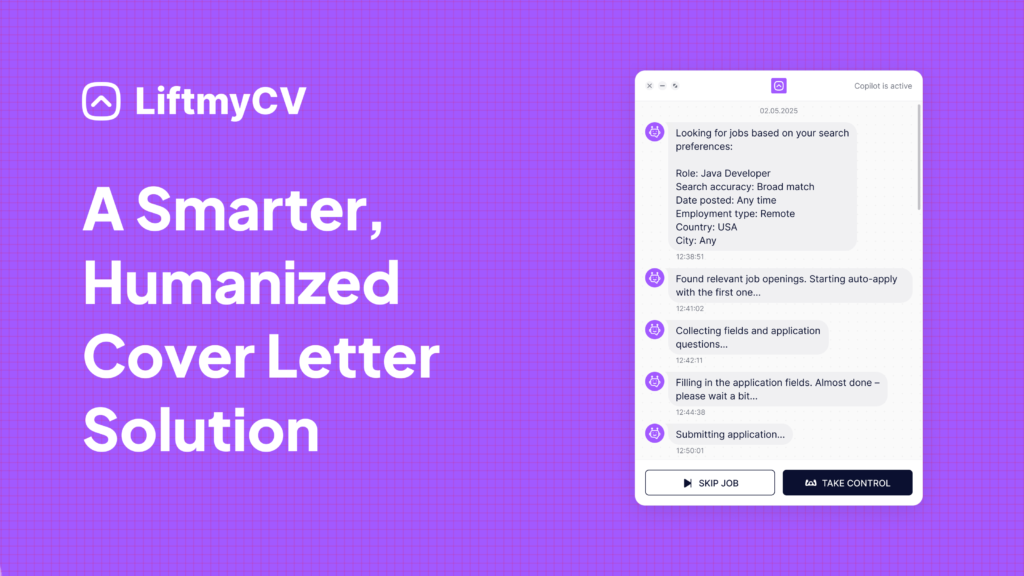
Instead of trying to replace you, the system:
- Speeds up search and application volume.
- Keeps your information consistent across applications.
- Leaves the “story injection” step explicitly in your hands, so your experience and voice remain front and center.
Let LiftmyCV search, match, and auto‑apply with humanized cover letters tailored to you. Start your AI job search co‑pilot today at LiftmyCV.
Strategic Trade‑Offs: When AI Helps And When It Hurts
Instead of a simple “pros and cons” list, it is more useful to think in terms of trade‑offs you are consciously choosing.
Key Trade‑Offs In Using AI For Cover Letters
The sweet spot in 2026 is to use AI heavily for search, structure, and ATS alignment, while keeping yourself firmly in charge of facts, stories, and values.
Where To Put Tools And CTAs In The Article
When you publish this piece on LiftmyCV’s site, you can make it more actionable by embedding tools at the moments of highest intent:
- After the “LiftmyCV Lab Results” section, place a “Scan my letter” button that analyzes a pasted cover letter for generic phrases, missing metrics, and style discrepancies with the resume.
- Inside the “Human‑In‑The‑Loop Framework” section, embed a “Cover Letter Humanizer” widget that guides users through the Zero‑Party Data and Story‑Injection steps with specific prompts.
These placements turn the article from a passive read into an interactive workflow that helps readers move from AI‑only letters toward human‑augmented ones, which is exactly where LiftmyCV performs best.
Methodology
Methodology: This guide is based on ongoing research by the LiftmyCV Career Lab conducted between May 2025 and January 2026. We analyzed the performance of 1,000+ AI‑assisted cover letters created and submitted through the LiftmyCV platform, focusing on response and interview invite rates. We then ran representative samples through five leading AI detection tools and compared these results with qualitative feedback from a network of 20+ HR and recruiting professionals. Finally, we reviewed how the January 2026 search and hiring ecosystem updates influence which AI patterns, AI hallucinations, and signals of recruitment bias lead to rejections and damage to personal brand integrity.


FAQ
Is it still safe to use AI for cover letters after the 2026 updates?
Yes, if you treat AI as a drafting assistant, not an autopilot. Use it for structure, then add specific results, stories, and metrics yourself to avoid generic patterns and AI hallucinations that triggers pattern‑recognition tools.
Can recruiters see if I used ChatGPT or Claude for my application?
They may not run a formal detector, but many can recognize “AI tone”: long, adjective‑heavy sentences, generic enthusiasm, and a lack of concrete, numbers‑backed achievements. Inconsistent details can also surface recruitment bias issues during manual reviews.
What is the “Human‑in‑the‑Loop” method for cover letters?
It’s a workflow where AI proposes the outline and phrasing, while you inject three to four experience anchors: specific outcomes, metrics, and personal stories tied to the role. This preserves personal brand integrity and keeps your narrative grounded in real results.
Will LiftmyCV’s tools help me bypass AI detection?
LiftmyCV doesn’t focus on bypassing detectors. Instead, it helps you restructure and humanize your content, align it with semantic search for resumes, and reduce AI hallucinations so your applications meet the higher standards of 2026 hiring algorithms without sacrificing authenticity.
Read Next
Do I Need a Cover Letter? When to Send One and When You Can Skip
When a cover letter is required, when you can skip it, and how to write a tailored one fast for every job.
Cover Letter vs Resume: The Real Difference and When You Need Both
A resume proves you can do the job; a cover letter explains why you fit. The key differences, what goes in each, and when you need both.

Cover Letter Examples and Templates That Get You More Interviews
Real cover letter examples for any situation - no experience, career change, internship, and more - plus the format and tips that get interviews.