
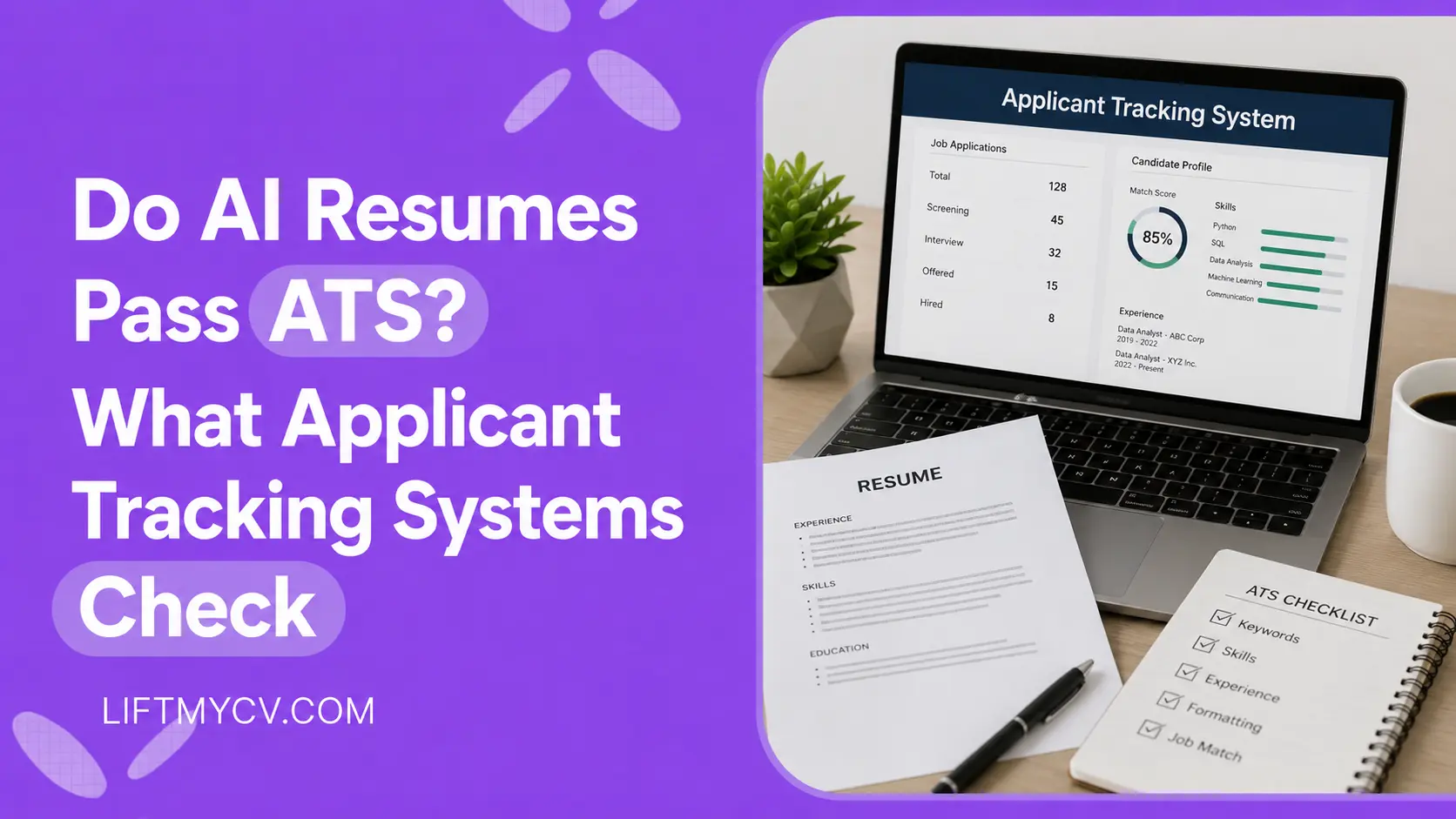
You used AI to write your resume, and now a quiet worry sets in. Will an applicant tracking system flag it, score it low, or toss it before a recruiter ever looks? It is a fair question when most applications are screened by software first.
Here is the reassuring part. ATS software does not care who or what wrote your resume. It parses for structure, keywords, and how well you match the job, not for whether a human or an AI typed the words. So yes, AI-generated resumes pass ATS systems, but only when they are formatted cleanly and tailored to the role. This guide explains what the software actually checks, why some AI resumes still get rejected, and how to make sure yours clears the screen.
If you want to skip the guesswork entirely, the safest route is a tool that builds the resume in an ATS-ready format and tailors it per job from the start, so passing the screen is built in rather than hoped for.
The Short Answer: Yes, If It Is Formatted Right
An AI-written resume can absolutely get through an applicant tracking system. The software reads your file as text, scores how closely it matches the job description, and ranks you against other applicants. None of that depends on the resume being written by a person.
What decides the outcome is format and relevance. A clean, single-column layout with the right keywords scores well whether AI drafted it or you did. A cluttered, generic one scores poorly for the same reason. The tool that wrote it matters far less than how it is structured and how closely it speaks to the posting.
What ATS Actually Checks
An applicant tracking system is not judging your writing style. It runs a few mechanical checks and produces a match score that decides whether you reach a recruiter.
- ›Can it read the file? Plain, single-column text parses cleanly. Tables, columns, and graphics often scramble.
- ›Do your keywords match the job? The system compares your wording to the posting and scores the overlap.
- ›Are the standard sections there? Clear experience, skills, and education headings help it map your data.
- ›How do you rank against others? Your match score is compared to the rest of the applicant pool.
Notice what is missing from that list: any check for AI authorship. The system has no field for it and no reason to look. It is built to find the closest match to the role, and a well-built AI resume is simply a strong match presented cleanly.
Did You Know?
Multi-column layouts and embedded graphics are one of the top reasons resumes get parsed incorrectly and filtered out. A plain ATS-friendly layout beats a designer-looking one almost every time.
Can ATS Detect an AI-Written Resume?
This is the fear that drives the question, so let us be direct. Applicant tracking systems do not detect AI authorship. They are keyword and parsing engines, not AI detectors. There is no flag in the score for “written by a machine,” because the system was never designed to find one.
It is not looking for AI. It is looking for a match.
Separate AI-detection tools exist, but they are not part of the ATS pipeline that screens your application, and their reliability on short documents like resumes is shaky. The real risk is not that you get caught using AI. It is sending a generic, off-target resume, which fails for the same reason a generic human-written one does. If you want the longer view on this, here is what actually happens with AI resume detection in real screening.
Pro Tip
Treat any AI draft as a starting point, not a finished file. Verify every claim, swap in real numbers from your own experience, and make sure you can defend each line in an interview. The AI handles structure and keywords; the accuracy is on you.
Build a Resume That Clears the Screen
LiftmyCV generates an ATS-friendly resume tailored to each job, so it passes the parser and matches the posting from the first draft. Pay as you go, no subscription required.
Why Some AI Resumes Still Get Rejected
If AI resumes pass ATS, why do people still hear nothing back? Almost always for one of two reasons, and neither has to do with AI being detected.
The first is formatting. If the AI tool exports a stylish two-column template full of icons and graphics, the parser may read it as a jumble and score you near zero. The second is generic output. An AI resume that is not tailored to the posting uses the wrong keywords, so the match score comes back low even though the layout is clean. Both are fixable, and both are common resume mistakes that sink strong candidates regardless of who wrote the file.
The pattern is clear. AI does not cause rejection. Bad formatting and generic content do. Use AI to produce a clean, tailored resume and you remove both problems at once.
How to Make an AI Resume Pass ATS
Getting through the screen is a few habits. Keep the layout to a single column with standard section headings and no tables or graphics. Mirror the language of each job posting so your keywords match what the system is scanning for. Tailor the resume to every role rather than sending one static file. And always review the draft, replacing vague phrases with real, verifiable results. The opening lines follow the same rule, and you can generate a tailored resume summary that mirrors each posting.
The hard part is doing all of that for every application by hand. This is where the right tool earns its place: instead of reformatting and rewriting for each job, you can have an ATS-friendly resume generated and tailored to each posting automatically, then check it before it goes out. So do AI resumes pass ATS? Yes, when they are clean and tailored. Build them that way and the software stops being an obstacle and starts working in your favor.
Frequently Asked Questions
Can an ATS detect an AI-generated resume?
No. Applicant tracking systems parse for structure, keywords, and match rate. They do not check whether a resume was written by AI, and there is no AI-authorship flag in the score. What they do reward is a clean format and strong keyword relevance to the job.
Are AI-generated resumes ATS-friendly?
They can be, when formatted correctly. A single-column AI resume with standard headings and keywords matched to the posting passes easily. The risk is not the AI, it is exporting a graphic-heavy template or leaving the content too generic.
Why did my AI resume get rejected?
Usually one of two reasons: a layout the parser could not read, such as columns or graphics, or content too generic to match the job. Neither is about AI being detected. Fix the format and tailor the keywords and the same resume performs very differently.
Is it okay to use AI to write your resume?
Yes, as long as you treat the output as a draft. Use AI to build a clean, ATS-friendly structure and tailor it to each role, then verify every claim so you can stand behind it in an interview. That combination passes the software and holds up with the recruiter.

Written by
Ruslan Nazarov is an SEO specialist focused on the careers and job search space. He writes about AI job search, resume optimization, and getting more interviews, drawing on hands-on work growing career and recruitment websites.
LinkedIn ↗
