
How to Find a Job in the UK: Complete Guide
Trying to figure out how to find a job in the UK in 2025 can feel like a full‑time job on its own. The market is still competitive, but if you understand where the real demand is, what employers expect, and how hiring…

Trying to figure out how to find a job in the UK in 2025 can feel like a full‑time job on its own. The market is still competitive, but if you understand where the real demand is, what employers expect, and how hiring actually works on the ground, you can give yourself a genuine edge.
This guide zooms in on the UK. If you want the location-independent playbook first, our complete guide on how to find a job walks through the whole process step by step.
Why Work in the UK
The UK still pulls in talent from all over the world because it combines big‑city opportunity with a pretty high standard of everyday life. You have London and its finance and tech ecosystem, but you also have fast‑growing hubs like Manchester, Leeds, and Edinburgh where commutes are shorter and housing is a bit less brutal.
For many people, the draw is a mix of things: career progression, access to global companies, and the chance to live in a place where you can finish work and be in a park, a pub, or at a concert in under an hour. When LiftmyCV users talk about why they moved, they rarely mention just salary; it is usually a blend of work, lifestyle, and long‑term options for family or future residency.
Top industries hiring now
If you spend ten minutes scrolling through a few major boards, you will see the same patterns repeat. Tech roles are still there, but not as wild as in 2021; healthcare and social care keep posting new vacancies; and professional services quietly soak up experienced people who know how UK businesses run. Sectors that are actively hiring include:
- Technology and digital: software engineering, data analysis, product, cloud, and cyber roles, often clustered around London, the South East, and a few big regional cities.
- Healthcare and social care: the NHS and private providers advertise a steady stream of openings for nurses, carers, and allied health professionals, especially where there are long‑term staff shortages.
- Finance and professional services: banking, insurance, audit, tax, and consulting remain strong for candidates with the right skills, even if hiring cycles are a bit slower than before.
- Creative, marketing, and media: agencies and in‑house teams need content, campaign, and design talent, particularly in London, Manchester, and Bristol.
- Hospitality and tourism: hotels, restaurants, and travel businesses are constantly backfilling front‑line staff and managers due to high turnover.
People who land offers fastest tend to do two things well: they aim at sectors that are genuinely hiring and they accept that entry‑level “dream roles” are rare, so they use their first UK job as a stepping stone rather than the final destination.
Salaries and work culture basics
Pay is heavily location‑driven. A mid‑level software engineer in London might earn noticeably more than someone in the same role in a smaller city, but rent, transport, and childcare can eat that difference very quickly. A lot of candidates only realise this when they plug real numbers into a cost‑of‑living calculator instead of guessing.
Day to day, UK work culture is fairly direct but polite. Meetings tend to start on time, people expect you to follow through on what you say you will do, and written communication carries a lot of weight. Most full‑time roles sit around 37-40 hours a week; unofficially, plenty of office workers still check emails in the evenings, but outright “always on” culture is less accepted than in some countries.
UK employment rules you should know
Before you start any serious job search, it is worth getting clear on a few basics that catch a lot of newcomers out.
First, there is a legal minimum wage that changes with age and is reviewed regularly; some cities and employers also talk about a higher “living wage,” which is voluntary but common in certain sectors. Second, full‑time employees are usually entitled to at least 28 days of paid holiday a year, which often includes public holidays, plus statutory protections around sick pay and parental leave.
You will also see different contract types: permanent, fixed‑term, temp, and zero‑hours. Each one handles notice periods, stability, and benefits differently, so do not assume they all work like a standard full‑time offer. And if you are not a British or Irish citizen and you do not already hold the right to work, every legitimate employer will ask for proof and, in many cases, will only proceed if you can meet their visa or sponsorship requirements.
Candidates who take an hour to read up on these rules upfront usually move through screening faster, because they can answer “What are your salary expectations?” and “Do you have the right to work in the UK?” without hesitating or contradicting themselves.
Best Ways to Search for Jobs in the UK
Once you understand the market, the next step is figuring out where to actually look. A lot of candidates start by firing off random applications and then wonder why nothing sticks. A better approach is to treat your search like a project: pick your main channels, set up systems, and show up there consistently (Source: expatica).
Top UK job sites (Indeed, Reed, Totaljobs, LinkedIn)
If you only used one method to find roles, it would probably be online job boards. But they work best when you treat them as tools, not lottery tickets. Here are the main platforms most UK job seekers lean on:
- Indeed and Totaljobs for a broad sweep of roles across sectors and locations.
- Reed and CV-Library for office, professional, and mid‑level roles.
- LinkedIn for anything where networking, visible expertise, and referrals matter.
Instead of scrolling endlessly, set up targeted alerts using job titles, salary bands, and locations you actually want. Apply quickly when a role is posted, and keep a simple tracker of what you have applied for, when, and with which version of your CV. When you use these job search sites UK wide with a clear system, you avoid sending the same generic application to twenty companies and getting twenty silent rejections.
Government job portals
The UK government runs its own job board, and it is more useful than many candidates realise, especially if you are open to public sector or entry‑level roles. You can:
- Use the central “Find a job” service for a mix of public and private sector vacancies.
- Check specialist portals like NHS Jobs if you are in healthcare, social care, or support roles.
- Look at local council websites for roles in administration, education support, housing, and community services.
These sites are not always as glossy as the big commercial boards, but they often host stable, well‑structured roles with clear salary bands and benefits. Shortlist a few of them, bookmark the pages, and get into the habit of checking them twice a week instead of only when you feel desperate (Source: gov.uk).
Local recruitment agencies
Recruitment agencies are still a major part of how hiring happens in the UK, especially for office, engineering, finance, and specialist roles. The mistake many people make is signing up with one generic agency and then waiting for magic to happen. A more practical approach is:
- Pick 3-5 agencies that genuinely focus on your sector and region.
- Send a tailored CV and a short, specific message about the roles you are targeting.
- Ask for a quick intro call so they can put a voice and story to your CV.
- Follow up every couple of weeks with concise updates, not daily “any news?” emails.
When you treat agency recruiters as partners rather than gatekeepers, they are more likely to think of you when a role comes in. Several LiftmyCV users have mentioned that their first UK job offer came not from a job board, but from an agency they had kept in touch with for a month or two.
How to Find a Job in the UK as a Foreigner
If you are trying to work out how to find a job in the UK as a foreigner, the big challenge is juggling two problems at once: getting an employer to say “yes” and making sure that “yes” fits the visa rules. The candidates who succeed are usually the ones who treat immigration, documentation, and job search as one combined project rather than three separate headaches.
Visa types (Skilled Worker, Health and Care, Graduate route)
Most non‑UK, non‑Irish citizens end up in one of a few common visa categories. You do not have to become an immigration lawyer, but you do need a basic idea of which route matches your profile before you start applying seriously.
- Skilled Worker visa: This is the main route for experienced professionals whose job is on the list of eligible occupations and whose employer holds a sponsor licence. Typical roles include software engineers, financial analysts, engineers, teachers, and many specialist office jobs. Salary thresholds apply, so that “great” offer only works if it hits the minimum for your role and hours.
- Health and Care Worker visa: A specific branch of the Skilled Worker route for nurses, doctors, carers, and some allied health roles. It usually has slightly lower salary thresholds, reduced fees, and can be more straightforward if your job is on the shortage list.
- Graduate route: If you complete an eligible degree in the UK, this route can give you time after graduation to work or look for work without immediate sponsorship. It is not a long‑term solution in itself, but it can be a bridge to a Skilled Worker visa once you have UK experience.
Before you send dozens of applications, take half an hour to check which route fits your background and whether your target roles generally offer sponsorship. That small bit of research saves you from chasing companies that simply cannot hire you, no matter how strong your CV is.
Sponsorship requirements
When people ask how to find a job in the UK for foreigners, what they really want to know is “Who is actually willing and able to sponsor me?” Not every employer can, and even those that can will only do it for roles that justify the cost and admin. In practice, most sponsored roles share a few things:
- The employer holds a valid sponsor licence.
- The job matches an eligible occupation code and meets the minimum salary rules for that code.
- The company genuinely needs your skills and cannot easily fill the role with someone who already has the right to work.
A realistic strategy is to build a shortlist of employers that already sponsor visas in your field, then focus your applications there. You can often spot them because they mention “Skilled Worker visa sponsorship available” or similar language in some of their adverts, and larger organisations in tech, finance, consulting, and healthcare tend to have more sponsorship experience.
Documents recruiters expect
Even if you are still abroad, UK recruiters will expect a certain level of preparation. They move quickly, and they do not always have time to coach candidates through basics. Get these pieces in place early:
- A UK‑style CV: Two pages max, clear headings, no photo, and concise bullet points focused on achievements, not just duties.
- A simple, honest explanation of your right‑to‑work situation: one or two sentences that say which visa route you are targeting and whether you need sponsorship now or in the future.
- Evidence of qualifications: scans of degrees, professional certificates, or licence registrations if you are in regulated fields like teaching, healthcare, or engineering.
- Contactable references: people who can speak about your recent work in English and respond promptly.
If you are serious about relocating, it helps to act like someone who could start tomorrow: know your visa route, be ready to explain your timeline, and have your documents organised. Recruiters remember candidates who make their lives easier, and that matters a lot when they are deciding who to put forward to a hiring manager.
How to Tailor Your CV for UK Recruiters
One of the quickest ways to lose a good opportunity in the UK is to send a CV that looks fine in your home country but “off” to a British recruiter. The good news is that once you understand the local format and a few unwritten rules, you can adjust your documents in a single afternoon and immediately come across more polished and easier to hire.
UK format CV
Think of a UK CV as a focused two‑page snapshot, not your entire life story. Recruiters skim in seconds, so your job is to make it painfully easy for them to see why you fit the role they are hiring for. A solid UK CV usually (sources: RobertWalters, gov.uk):
- Stays on one or two pages, with clear section headings and plenty of white space.
- Starts with your name and contact details (email, mobile, LinkedIn), not a photo, date of birth, or marital status.
- Uses a short profile at the top: 3-4 lines that spell out your role, level, and areas of expertise in plain English.
- Lists recent experience first, with bullet points that show what you delivered, not just what you were “responsible for”.
- Includes education, key skills, and any certifications that genuinely matter for the role.
A practical way to check your format is to open a couple of UK job ads in your field and then ask yourself: “If a stranger looked at my CV for 10 seconds, would they instantly see that I match this job title and level?” If the answer is “not really,” the structure needs tightening.
Cover letter expectations
Cover letters are not always mandatory, but when they are, they are treated as a quick test: can you explain why you want this job, at this company, right now? That is it. No need for dramatic language or a full autobiography. In the UK, a good cover letter tends to:
- Address the hiring manager or team where possible, rather than “To whom it may concern”.
- Link your experience clearly to the main requirements in the job description.
- Show that you have done basic research on the organisation and understand what they do.
- Stay to one page, with short paragraphs and a straightforward, professional tone.
If you are short on time, it is better to write three sharp, customised paragraphs than to paste the same generic letter into twenty applications. Many LiftmyCV users find that once they have one strong UK‑style template, tweaking it for each role takes minutes rather than an hour.
Common UK hiring mistakes to avoid
Even strong candidates often make avoidable mistakes that immediately put UK recruiters off. The patterns repeat so often that you can almost predict them. Typical problems include:
- Overloaded CVs: four or five pages, long dense paragraphs, or every job since high school listed in full detail.
- Non‑UK elements: photos, excessive personal data, or very unusual fonts and graphics that make the CV look more like a brochure than a professional document.
- Vague achievements: bullet points that read like job descriptions, with no numbers, outcomes, or evidence of impact.
- Ignoring gaps: unexplained breaks of a year or more with no brief line to clarify what you were doing.
If you fix these basics and align your layout with a clean UK format, you instantly make it easier for recruiters to say “yes” and move you to the next stage. This is also the point where tools like an AI resume generator or services such as LiftmyCV can help you reshape the content for the UK market without losing your own voice.
How LiftmyCV Helps You Get a Job in the UK
Job hunting in the UK often feels like a second job: rewriting your CV, checking several platforms, and trying to apply before a role disappears. LiftmyCV removes most of that manual work and gives you tools to run your job search the way you prefer, from full automation to controlled, hands-on applying.
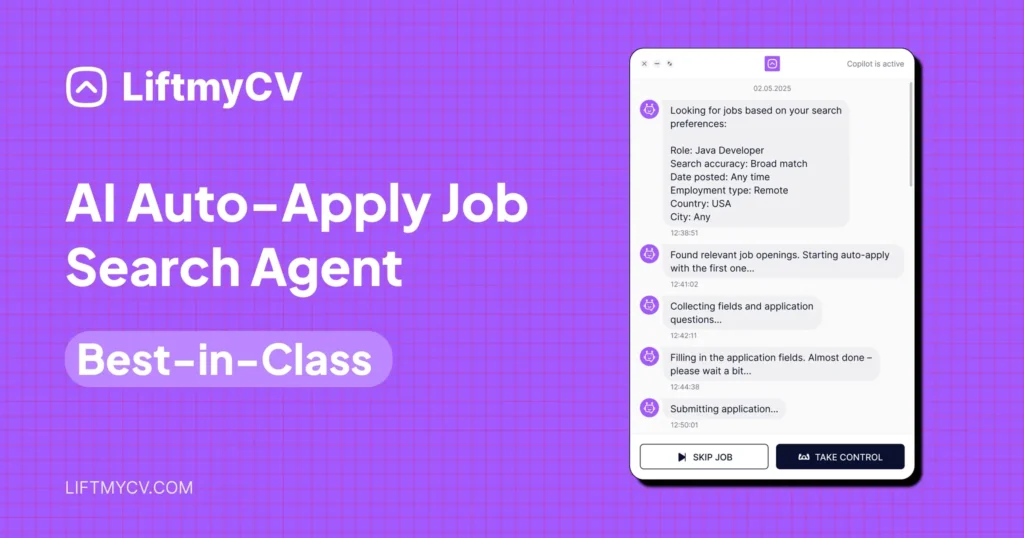
- Automated Job Search: LiftmyCV automates the hardest parts of job hunting by continuously scanning leading 11 job boards and ATS platforms, matching new openings with your profile, and preparing tailored applications.
- AI Matching: LiftmyCV’s AI agent scans vacancies across top UK job boards and compares them with your CV and profile. Instead of pushing every job it finds, the system filters out irrelevant roles and surfaces only positions that closely match your skills, experience, and preferences. This increases your chances of getting responses while reducing noise and guesswork.
- Job-Specific CVs and Cover Letters: Every application gets its own tailored CV and cover letter built directly from the job description. You edit the details, and the result feels like a focused, employer-specific submission instead of another reused template.
- Autopilot or Copilot: LiftmyCV offers two working modes. Copilot lets you stay in control while the AI assists with filling fields, adapting your CV, or generating cover letters as you review each application. Autopilot handles the entire process for you, from matching to submitting, making your job search run entirely in the background.
- First and Stealth Apply: LiftmyCV monitors major ATS platforms (Workable, Lever, BreezyHR, Ashby, Recruitee, SmartRecruiters, and Greenhouse) for fresh openings posted within the last 24 hours. First Apply alerts you early so you can respond before the applicant pool grows. Stealth Apply runs in the background and submits applications automatically without needing a browser extension.
Ready to get started? Join LiftmyCV today at and try your first 3 applications for free to automate your job search and start landing new interviews on autopilot, hassle free.
Where to Look for Jobs in London
If you are set on London, it helps to be honest about one thing upfront: the city can be brilliant for your career and brutal on your budget at the same time. The trick is to target the parts of the market where London genuinely gives you an advantage, instead of chasing every shiny job title you see on a board.
Finance, tech, hospitality, creative
London is really a collection of job markets sitting on top of each other, not one single “London job scene.”
- Finance and professional services: Think banking, insurance, asset management, fintech, and the big audit and consulting firms. Roles range from graduate analyst programs to specialist risk, compliance, and product positions. Hiring can be competitive, but once you are in, progression and internal mobility are strong.
- Tech and digital: You will find everything from early‑stage startups in shared offices to global tech companies with huge campuses. Product managers, engineers, data analysts, UX designers, and cyber specialists are in regular demand, though many roles now blend office and remote days.
- Hospitality and leisure: Hotels, restaurant groups, pubs, and venues are always looking for people, largely because turnover is high. If you need to get into work quickly, this can be one of the fastest ways to secure a job, with options to move into supervision and management once you prove yourself.
- Creative and media: Advertising, film, TV, publishing, and agencies cluster around London more than anywhere else in the UK. Entry paths can be messy and low‑paid at first, but once you build a network, London’s density of agencies and studios gives you more shots at freelance and permanent roles.
When you put all of this together, the question becomes less “Are there jobs in London?” and more “Which London market actually fits my skills, my energy levels, and the lifestyle I can realistically afford?”
How Americans and expats can apply
If you are looking for jobs in London for Americans or other expats, your application strategy needs a couple of extra layers. You are not just convincing an employer that you can do the job; you are also reassuring them that you understand the visa rules, the move, and the cultural switch. A practical approach looks like this:
- Translate your experience: Swap out US‑specific job titles or jargon for plain terms a UK hiring manager will recognise. A “Regional VP of Sales” might simply become “Sales Director,” and college “GPA” can be turned into clear achievements instead of a raw number.
- Address location and visas openly: In your CV or cover letter, add a brief line explaining where you are now, when you could move, and whether you would need sponsorship. Employers do not like guessing games, but they are usually fine with clarity.
- Show you understand London life: You do not have to pretend you have lived there for years, but it helps to show you have thought about housing, commuting, and costs. Mentioning that you have already researched specific areas, transport lines, or relocation timelines makes you look more serious than someone who simply writes “open to relocating to London” and leaves it there.
If you are coming from abroad, it also pays to over‑prepare for time zones and logistics. Being the candidate who always answers emails promptly, shows up to video interviews on time despite the time difference, and has a clear plan for the move makes you feel far less risky to a London hiring manager who has never met you in person.


Read Next

How to Get Into Graphic Design and Land Your First Design Job
Choose a design lane, build a three-project portfolio with case studies, and apply while 9,064 graphic design roles are open.

How to Find a Job: The Complete Step-by-Step Guide
How to find a job step by step: where to search, how to get past the ATS, the best way to apply faster, and how to automate your job search with LiftmyCV.

How to Become a Copywriter, From First Sample to First Paid Job
Pick a copy lane, build four samples that prove it, and apply while 1,944 copywriter roles sit open. Pay data and timelines included.