
How to Get a Job in Dubai: Complete Guide for 2025
Discover how to get a job in Dubai. Learn about top industries, job sites, visa requirements, salaries, and how AI tools can help you apply faster.
Why Dubai Remains a Top Career Destination
If there’s one city that never stops reinventing itself, it’s Dubai. The skyline keeps changing, the industries keep expanding, and the appetite for global talent only grows stronger. In 2025, the UAE has officially ranked first in global hiring sentiment, leading the world with a +48% Net Employment Outlook, according to the ManpowerGroup Q3 Labour Survey. Employers aren’t just recruiting to fill roles, they’re competing to attract people who can help them innovate in digital transformation, sustainability, and AI-driven operations.
The city’s economy now supports more than 9.4 million workers, with an unemployment rate of just 1.9%, one of the lowest anywhere on the planet. These numbers speak for themselves: opportunities in the Emirates are not slowing down. As Younus Al Nasser, CEO of the Dubai Data and Statistics Establishment, recently stated, Dubai’s 2025 labour force survey “captures how innovation and inclusion are shaping a sustainable, high‑performance economy built to last”.
But numbers only tell part of the story. People move here because Dubai offers something rare, tax-free income and a lifestyle that merges ambition with comfort. The city’s safety, connectivity, and forward‑thinking policies make it just as appealing for software engineers and entrepreneurs as for healthcare professionals and hospitality workers. Whether you’re eyeing a corporate role in DIFC or a creative position in Media City, you’re stepping into a city that genuinely runs on ambition and optimism.
Understanding Dubai’s Job Market
Dubai’s job market in 2025 tells a story of evolution rather than recovery. The Emirate has moved well past the pandemic‑era hiring rebound; it’s now firmly in a growth phase driven by economic diversification, digital transformation, and global mobility. The latest UAE Labour Force Survey shows record participation levels, with 9.4 million active workers and just 1.9 percent unemployment, the lowest in the region.
That strength isn’t limited to a single sector. As Dubai’s government continues to invest in smart‑city infrastructure, renewable energy, and international finance, demand for specialized professionals has expanded beyond the usual oil‑and‑construction narrative. For job seekers, that means more competition, but also significantly more room to find good fits aligned with skills, education, and career goals.
In‑Demand Industries
The job landscape in Dubai has become broader and more specialized. Tech continues to dominate, but there’s also rapid expansion in construction, logistics, and finance, a pattern confirmed by the 2025 UAE Labour Market Report. Here’s what’s driving the growth:
- Technology and Startups: Government incubators like Hub71 and DIFC Innovation Hub have made Dubai a regional base for AI, Web3, and cybersecurity hiring. Roles in data science, fintech, and software development are filling faster than ever.
- Construction and Real Estate: Projects under the Dubai 2040 Urban Master Plan are keeping architects, project managers, and sustainability experts in high demand.
- Healthcare: Between telemedicine expansion and investment in new private hospitals, opportunities are opening up for physicians, allied health professionals, and clinical researchers.
- Finance and Banking: FinTech, blockchain compliance, and risk management are reshaping hiring priorities across the Emirate’s banking sector.
- Hospitality and Tourism: Even post‑Expo, demand from luxury hotel brands and tourism operators continues to rebound, fuelled by international events and increased visitor traffic.
Skills and Traits Employers Prioritize
Recruiters in Dubai have become sharper about value. They look for candidates who merge technical expertise with adaptability, particularly those comfortable working across cultures and remote setups. Soft skills such as communication, accountability, and flexibility now matter as much as credentials. One Dubai‑based recruiter at Aspire Global summarized it well: “Specialized skills open the door, but emotional intelligence keeps you in the room”.
Salary Landscape in 2025
For professionals evaluating a move, the financial outlook is bright. Salaries remain tax‑free and continue to rise in emerging sectors. The average monthly income now ranges around 21,500 AED (≈ $5,850), rising steeply for specialized technical and managerial roles. Here’s a snapshot of what professionals can expect:
| Industry | Average Monthly Salary (AED) | 2025 Hiring Outlook |
| Technology & Startups | 15,000 – 35,000 | Rapid expansion via AI, Web3 |
| Finance & Banking | 12,000 – 30,000 | Stable with FinTech growth |
| Healthcare | 10,000 – 25,000 | Rising with public investment |
| Construction & Real Estate | 7,000 – 20,000 | Strong due to D2040 projects |
| Hospitality & Tourism | 5,000 – 12,000 | Consistent, post‑Expo rebound |
Many expats still cite housing as the biggest monthly expense, but compared with other global business hubs like London or Singapore, Dubai’s zero income tax keeps take‑home pay significantly higher. Add a vibrant community, endless events, and clear visa pathways, and it’s easy to see why the city still tops the list for professionals building international careers.
How to Apply for Jobs in Dubai
Getting hired in Dubai is both about strategy and timing. The city’s job market moves fast, but employers still prioritize preparation over speed. Landing a solid offer requires methodically choosing where and how to apply, then tailoring your resume and outreach for the local system.
Best Dubai Job Websites and Portals
Dubai’s hiring ecosystem has evolved into a hybrid of local job boards and global networks. As of mid‑2025, these platforms consistently lead job placements for expats :
- LinkedIn Jobs: Still the most active channel for mid‑ to senior‑level professionals. Roughly 80% of Dubai employers vet candidates through LinkedIn before interviews.
- Bayt.com: Well‑established in the Gulf for over two decades. Known for bilingual listings and regional roles.
- GulfTalent: A go‑to for finance, engineering, and project management positions.
- Naukrigulf: Popular among Asian job seekers and a reliable source for cross‑industry openings.
- Dubizzle Jobs and Dubaicareers.ae: Excellent for local contract or government roles.
- JobSeeker Visa Section of u.ae: For candidates planning to enter Dubai specifically on a job‑seeker visa valid for 60-120 days.
Expert recruiters suggest applying through two or three quality channels rather than blasting CVs across dozens of sites.
“Targeting is everything in Dubai,” says Marwan Osman, recruitment director at GulfTalent. “The right role often comes from a focused search coupled with timely follow‑ups.”
How to Format Your CV for Dubai Employers
A Dubai‑ready resume has its own structure. Hiring managers, as outlined in the UAE Ministry of Human Resources guidelines, expect concise detail and clear authenticity over generic flair :
- Keep it concise, two pages max. List your most recent roles first in reverse chronological order.
- Include a professional summary. Emirati recruiters prefer a three‑sentence overview up top summarizing your skillset and experience level.
- Add basic personal details. While most Western CVs omit nationality or visa status, in UAE applications you can state both (plus current location and availability).
- Use relevant keywords. Many companies rely on applicant tracking systems (ATS). Including job‑relevant terms boosts your CV’s visibility.
- Attach credentials clearly. Attested academic documents and professional certifications can be decisive for foreign applicants.
You can optionally embed a short video introduction, a trend growing rapidly in 2025 among marketing, real estate, and customer‑facing roles.
Applying Directly to Companies and Through Recruiters
Sending applications through company websites and government‑linked portals like dubaicareers.ae ensures authenticity. Direct employer submissions are strongly favored by compliance‑conscious HR teams who must register offers with the Ministry of Labour. However, credible recruitment agencies still help bridge gaps for newcomers unfamiliar with local processes. Firms like Michael Page Middle East, BAC, and Charterhouse focus on specialized placements, while smaller consultancies assist candidates with visa coordination and relocation logistics.
Timing also matters. According to MyDubaiCareer’s 2025 survey, January to May and September to October remain the prime months for hiring, coinciding with new fiscal cycles.
Visa and Work Permit Requirements
Before you can begin working in Dubai, you must secure legal authorization, and that means holding the correct UAE employment visa. This step is what officially transforms a job offer into a recognized work contract under MoHRE (the Ministry of Human Resources and Emiratisation).
In 2025, the UAE government continues to modernize its visa system to attract skilled professionals, freelancers, and investors through simplified and distinctly categorized programs. The latest New Employment Visa Rules (2025) introduced digital applications, shorter processing times, and clearer work‑permit classifications for private, free‑zone, and government employees.
While the specific steps vary depending on your job type and sponsor, most applicants now complete the full process online within 10-20 business days. These visas also serve as residency permits, meaning you can open a bank account, lease housing, and access healthcare once it’s issued.
Types of Employment Visas in the UAE
Working legally in Dubai always starts with securing the right visa. In 2025, the UAE maintains several streamlined visa routes to attract both technical talent and entrepreneurs.
- Standard Employment Visa: The most common option for expats hired by a UAE‑licensed company. This visa is valid for two years and sponsored directly by the employer. It ties the worker’s legal status to the company that issued the offer, though renewals are simple if the contract continues.
- Green Visa: Designed for skilled professionals, freelancers, and investors, it provides five‑year residency without needing an employer sponsor. Holders can self‑sponsor family members and switch jobs or clients freely. Applicants must show a minimum salary of AED 15,000, a recognized degree, and proof of stable income from UAE or foreign clients.
- Golden Visa: The UAE’s long‑term residency track for investors, entrepreneurs, researchers, and elite professionals. It grants ten years of residency and eligibility for government incentives such as priority medical care and simplified renewals. Typical thresholds include real‑estate investments worth AED 2 million or innovative projects certified by local authorities.
- Digital Nomad (Remote Work) Visa: A one‑year renewable program allowing foreign employees or entrepreneurs to live in Dubai while working for overseas companies. Applicants must prove at least USD 5,000 in monthly income, valid international health insurance, and remote employment or business ownership abroad.
Documents Required for an Employment Visa
Most employment‑based visas share these basic requirements :
- Passport valid for at least six months
- Passport‑sized photographs (as per UAE standards)
- Signed employment contract issued by a licensed UAE employer
- Entry permit or work permit pre‑approved by the Ministry of Human Resources and Emiratisation (MoHRE)
- Attested educational and professional certificates
- Medical fitness certificate from an authorized UAE health center
- Proof of employer‑provided health insurance
- Emirates ID registration documents
Employers must also hold a valid trade license and ensure the job title aligns with their registered business activities. Job offers falling outside the company’s trade scope can be rejected automatically by MoHRE’s compliance system.
Step‑by‑Step Application Process (2025)
The current visa framework simplifies paperwork through digital channels. Here’s how it flows for most job seekers :
- Quota Approval – Employer requests work‑visa quota from MoHRE; approval depends on company size and labor allocation.
- Employment Contract Submission – Both parties sign and submit a contract (in English, Arabic, and sometimes a third language).
- Work Permit & Entry Visa – MoHRE issues the initial entry permit, generally valid for 60 days for two‑year employment visas.
- Arrival in the UAE – The employee enters the country to complete medical tests and Emirates ID biometrics.
- Residence Visa Activation – The visa converts into a residence permit, now digitally linked to the Emirates ID rather than stamped in the passport.
- Post‑Arrival Orientation – Some free zones require newcomers to attend induction briefings or safety training sessions before starting work.
Sponsorship and Timeline
For standard work visas, the employer is always the sponsor, and the end‑to‑end timeline averages 10 to 20 business days if documentation is complete. Green and Golden visa applicants apply independently through the GDRFA or ICP Smart Services portal, often receiving approval in under a month.
Tips for Different Job Seekers
Every job seeker’s path to Dubai looks a little different. The city’s enormous expat workforce, now representing more than 200 nationalities, means hiring practices and expectations can vary widely depending on your country of origin, skill set, and professional stage. Whether you’re an American exploring relocation, a remote worker looking to base yourself in the UAE, or a recent graduate seeking your first international job, the key is understanding how the system fits your profile before you apply.
Recruiters in Dubai emphasize two factors: timing and targeting. Applying during peak hiring seasons (typically January – May and September – October) gives you a real advantage, and customizing your resume for the UAE market often determines who lands the interview. The following sections break down what that means in practice for major applicant categories, from Western expats to digital nomads and first‑time job seekers.
For Americans and Other Western Expats
Americans continue to do well in Dubai’s job market, especially in finance, tech, healthcare, marketing, and education. The city already hosts nearly 40,000 U.S. citizens, most employed by multinational companies or private schools following the U.S. or IB curriculum.
If you’re applying from the United States, start your search remotely through trusted sites like LinkedIn, GulfTalent, or Bayt.com. Recruiters encourage candidates to apply between January and May, Dubai’s prime hiring window. During these months, HR teams reset budgets and expand headcount for new projects.
For Americans, the best strategy is clarity. Customize your resume to reflect UAE‑specific experience or certification equivalents, and remember, some details that are optional back home (like nationality or visa status) are expected locally.
As Pacific Prime’s guide puts it, “Your goal isn’t just to get noticed; it’s to sound ready to relocate”.
High‑demand roles for Western expats in 2025 include:
| Role | Typical Annual Salary (USD) | AED Equivalent |
| Primary Care Physician | 50,000 – 161,000 | 186,000 – 594,000 |
| Finance Manager | 78,000 – 120,000 | 286,000 – 440,000 |
| Cybersecurity Specialist | 48,000 – 74,000 | 175,000 – 273,000 |
| Teacher (U.S./IB Curriculum) | 23,000 – 103,000 | 87,000 – 380,000 |
While jobs are competitive, the advantage for Americans and Western professionals lies in English fluency and familiarity with international business culture. Nearly 70% of Dubai’s population are expats, so language barriers rarely stand in the way.
For Remote Workers Seeking Dubai‑Based Contracts
Dubai’s push toward flexible work models means it’s now easier than ever to live in the UAE while working for companies abroad. Through the Digital Nomad Visa, remote professionals can base themselves in Dubai without a local employer, provided they earn over USD 5,000 per month.
The digital‑nomad tier now attracts freelancers in tech, content, design, and consulting, who value stable internet, tax‑free earnings, and long‑stay options. Housing developments like Dubai South and Jumeirah Village Circle are especially popular with remote professionals seeking co‑living spaces.
A 2025 expat report by Shozon noted a 20% rise in international contractor visa applications, showing how Dubai’s infrastructure supports both full‑time and hybrid workers.
For Fresh Graduates and Young Professionals
Opportunities for new graduates are broader than ever. Internships, entry‑level analyst programs, and hospitality management tracks account for a rising share of 2025 job openings. Government‑backed initiatives such as Digital Dubai and Dubai Future Labs now reserve some early‑career roles for foreign graduates with proven digital or AI skills.
Career advisors recommend that graduates not rush applications blindly but instead build digital portfolios or proof‑of‑work demos to stand out. Recruiters consistently highlight that “tangible work beats glossy resumes.” A visible project on GitHub, a marketing case study, or even volunteer experience in multicultural settings can carry more weight than GPA alone.
Networking remains critical too: job fairs, university partnerships, and Dubai Chamber of Commerce events are effective entry points for freshly minted professionals.
How AI Tools Like LiftmyCV Simplify Job Search in Dubai
If you’ve ever tried applying for jobs in Dubai manually, you know the process can feel endless, dozens of forms, repetitive uploads, and application systems that filter out strong candidates before a recruiter even reads the resume. In 2025, that dynamic is finally shifting. AI‑driven job search assistants like LiftmyCV are redefining how professionals find and apply for work across the Gulf.
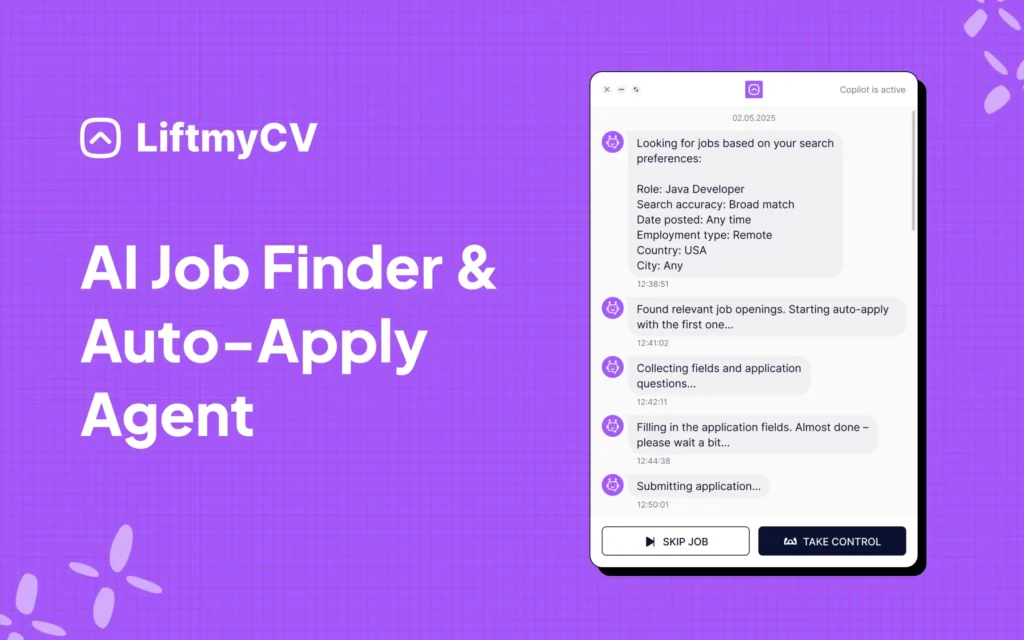
LiftmyCV was built around a simple question: What if job seekers could use the same level of automation that recruiters use?
This AI‑based platform now helps thousands of users manage full job searches from start to finish, automatically scanning listings, tailoring resumes, generating cover letters, and submitting completed applications to over ten integrated job boards, including LinkedIn, Greenhouse, Wellfound, and Glassdoor.
“Recruiters already use AI to eliminate candidates. It was time job seekers had AI on their side,” said Dan Zaitsev, LiftmyCV’s founder, in a recent interview. That statement sums up the platform’s ethos: give power back to candidates through intelligent automation.
Key Features that Matter for Dubai Job Seekers
- Automated Job Search Agent & Auto-Apply Tool: LiftmyCV’s AI agent scans 10 major job boards for roles aligned with your skills and preferences. Once a match is identified, it customizes your resume and cover letter and submits the application automatically in seconds.
- AI‑Powered Role Matching: LiftmyCV analyzes each job description, compares it against the user’s resume, and calculates a match score. The system filters out irrelevant roles, ideal for job markets like Dubai, where listings are abundant but often overlapping across portals.
- Resume per Job Generator: Instead of sending one generic resume, the tool creates a new, ATS‑optimized resume for every application. It updates keywords, emphasizes relevant achievements, and aligns formatting with what Dubai employers expect.
- AI Cover Letter Builder: Each application can include a personalized narrative tailored to the job title and sector. For Dubai specifically, where hiring managers value culturally fluent communication, this contextual writing style helps humanize each application and avoids the “bot-like” tone seen in template letters.
- Autopilot and Copilot Modes: The Autopilot mode can run job searches continuously, applying while users sleep or work elsewhere. For stricter control, the Copilot mode pauses before submission, letting you edit, approve, or skip each application, a popular choice among professionals applying for high‑impact corporate or governmental roles.
- Application Tracking Dashboard: Every submission is automatically recorded, with job links, status updates, and attached files in one organized interface. This replaces the need to maintain manual spreadsheets, especially useful for those applying across multiple Emirates or job categories simultaneously.
Real‑World Time Savings
By mid‑2025, LiftmyCV users had collectively submitted over 49,000 job applications through the platform, with many reporting that they saved five to seven hours per week and received faster callbacks than when applying manually. Analysts note that such tools are particularly helpful for international applicants based in the U.S. or Europe who want to target roles in Dubai without staying up for time‑zone‑adjusted postings.
In short, AI isn’t replacing human effort in the Dubai job market – it’s amplifying it.
A well‑built resume and professional experience still matter, but platforms like LiftmyCV handle the logistical grind: finding, matching, applying, and tracking, while candidates focus on the part that really counts: preparing for interviews.
Get started for free at app.liftmycv.com


FAQ
What are the best job sites to find work in Dubai?
Top platforms include LinkedIn, Bayt, GulfTalent, Naukrigulf, and Dubizzle Jobs. Many global employers also post Dubai openings directly on their company websites.
Do I need a work visa before applying for jobs in Dubai?
You can apply for jobs from abroad, but you’ll need an employment visa once hired. Most companies sponsor foreign employees, covering the costs of the visa and work permit.
Which industries hire the most foreign professionals in Dubai?
The most active sectors include IT, finance, construction, hospitality, healthcare, logistics, and real estate. Many of these industries actively recruit expats for both on-site and hybrid roles.
How much can I expect to earn working in Dubai?
Salaries vary by field and experience. Tech and finance professionals often earn between AED 15,000-35,000 monthly, while hospitality and administrative roles average AED 8,000-15,000.
How can AI tools like LiftmyCV help me find jobs in Dubai faster?
LiftmyCV automates your job search by scanning major Dubai job portals, matching roles to your resume, and auto-applying with optimized CVs and cover letters, saving hours of manual effort.
Read Next

How to Get Into Graphic Design and Land Your First Design Job
Choose a design lane, build a three-project portfolio with case studies, and apply while 9,064 graphic design roles are open.
How to Find a Job: The Complete Step-by-Step Guide
How to find a job step by step: where to search, how to get past the ATS, the best way to apply faster, and how to automate your job search with LiftmyCV.

How to Become a Copywriter, From First Sample to First Paid Job
Pick a copy lane, build four samples that prove it, and apply while 1,944 copywriter roles sit open. Pay data and timelines included.