
Best Job Search Strategies for Recent Graduates
Learn where to apply, how to create your first resume, how to stand out without experience, and how AI tools can help you get interviews faster.

Graduating in today’s market means entering a job landscape where employers expect more real experience and clearer signals of skills, even for junior roles. This guide breaks down how to search, when to start, where to look, and how to use tools like LiftmyCV to make the process faster and less overwhelming.
Why Job Search Is Hard for Recent Graduates
The phrase “college graduates job search difficulty” is not just a feeling; multiple studies show that lack of practical experience and rising requirements make entry-level hiring tougher than it used to be. At the same time, there are still real opportunities for graduates who learn to position what they already have, instead of waiting until they feel “fully qualified.”
Lack of experience
Many employers now expect internships, projects, or part-time experience on top of a degree, even in junior roles. One survey cited by the National Association of Colleges and Employers found that over 90% of employers prefer candidates with relevant work experience, which immediately puts graduates with no internships at a disadvantage.
This creates a gap where the job search for recent graduates can stall: you need experience to get a job, but a job is the fastest way to get experience. The way out is to treat internships, volunteer work, campus projects, and freelance or contract work as valid “experience” and present them that way on your resume.
High competition
Every year, hundreds of thousands of new graduates enter the job market in each major economy, all targeting a relatively small pool of entry-level roles. When fewer junior roles are posted, competition intensifies and small edges like tailored resumes, networking, and relevant projects matter far more.
Career surveys note that many graduates struggle most not with finding listings, but with standing out enough to get interviews in a crowded field. That is why “apply everywhere” usually backfires: generic applications disappear in a sea of similar profiles.
Entry-level roles asking for experience
Over the last several years, job listings labeled “entry level” have quietly raised the bar, adding more skills and prior experience. One HR executive quoted by the BBC noted that employers have increased experience requirements and the number of skills requested in junior job ads as they try to reduce perceived hiring risk.
That means many “entry-level” roles are really “early-career” roles that assume internships or project experience, not a blank slate. The practical takeaway: you do not need to meet 100% of requirements, but you do need to show clear evidence that you can learn and perform core tasks from day one.
“Employers rarely expect graduates to know everything, but they do expect evidence that you can learn fast and deliver value quickly.” – advice paraphrased from career coaches working with new grads at major universities (Source: economics.virginia.edu)
When Should Recent Graduates Start Their Job Search
Understanding when to start job search before graduation can remove a lot of stress in your final year. Timing alone will not guarantee a job, but it can move you out of the last-minute rush where roles are already filled and competition is at its peak.
Final year timeline
Most career centers recommend starting active job search in your final year, often 4-6 months before graduation for larger companies and 1-3 months for smaller organizations. Big graduate schemes, consulting, tech, and finance roles sometimes open applications almost a year in advance, while startups and smaller firms tend to hire closer to their actual needs.
If you want a smoother transition, treat the first half of your final year as your “research and networking” window, and the last semester as your “application and interviewing” phase. That structure gives you time to build relationships and polish your materials before sending serious applications.
Internships vs full-time
Internships and co-op roles remain one of the strongest bridges into full-time work for recent graduates. LinkedIn data on the class of 2023 showed that graduates who held internships were nearly 30% more likely to start a full-time job within six months of graduation than classmates without internship experience (Source: LinkedIn).
Research on internships and employment also finds that graduates with internship experience receive significantly more interview invitations than those without, reinforcing the idea that internships function almost like extended auditions. If you are in your final year and can still fit in an internship, even part-time or remote, it can dramatically improve your starting point.
Common timing mistakes
Graduates often make three timing mistakes: waiting until after exams to do everything, applying intensively for two weeks and then stopping, and focusing only on roles with immediate start dates. Career specialists note that a more consistent approach, such as applying to a set number of relevant roles per week and following up, tends to outperform “panic applying” right after graduation.
Another mistake is assuming you must accept the first offer, even if it is a poor fit, just because it arrived early. While financial realities matter, it is reasonable to balance short-term income (temporary work) with continuing to pursue roles that better match your skills and goals.
Where to Search for Graduate Jobs
If you are unsure where to search for graduate jobs, start by combining broad platforms with more targeted channels. The goal is not to be everywhere, but to be visible in the right places where employers actively look for junior talent.
Job boards
Large job boards like LinkedIn Jobs, Indeed, and Glassdoor carry many listings suitable for a graduate job search, especially in business, tech, and marketing. These platforms let you filter by experience level, location, salary range, and remote options, which is useful when you are still exploring.
However, relying only on public job boards can keep you stuck in the most competitive part of the market. Many employers also recruit from smaller niche boards focused on specific fields like design, software engineering, or nonprofit work, where your profile may stand out more.
Graduate programs
Formal graduate programs and rotational schemes are common in larger companies, banks, consultancies, tech firms, and some government agencies. These programs usually have structured training, clear timelines, and intakes once or twice a year, which can be appealing if you want predictability and mentoring.
Because they are competitive, you will need a strong, targeted application that highlights internships, projects, leadership, or campus involvement. Many graduates who succeed with these programs begin researching them months ahead and attend virtual or on-campus events to meet recruiters.
Company career pages
Company career pages often list roles before they appear on big job boards or in more detail than third-party sites. For smaller companies and startups, the careers page might be the only place where jobs are advertised.
Setting up a weekly routine to check career pages for 10-20 target companies keeps you focused on employers you genuinely care about, instead of only chasing whatever appears in your feed. This is also where tools that monitor and surface relevant new listings can save you time.
University and alumni resources
University career centers, job portals, and alumni networks still play a strong role in helping recent graduates find early opportunities. Some employers specifically post entry-level roles or short-term projects through these channels because they want new graduates rather than experienced hires.
Alumni can be particularly valuable for informational interviews, referrals, and honest insights about roles and companies. Research from university career offices shows that students who engage in networking and informational interviews are far more likely to secure internships and jobs than those who rely only on online applications.
“Networking is not about asking for a job. It is about asking for information, then using that information to become the kind of candidate people want to recommend.” – paraphrased from career development research on informational interviews.
Best Job Search Strategies for Recent Graduates
This is the core: the best job search strategies for recent graduates balance targeted applications, clear positioning of your experience, and consistent relationship-building over time. Instead of chasing every posting, you will progress faster by focusing on fewer, better-aligned roles and sending stronger applications to each.
Applying strategically, not everywhere
Mass applying with one generic resume usually leads to silence, not interviews. Recruiters and applicant tracking systems (ATS) look for alignment between the job description and your resume, so generic documents often fail to reach a human reviewer.
A better strategy is to define 2-3 role types you want (for example, marketing coordinator, data analyst, or junior software engineer) and build one strong base resume for each track. Then, you lightly adapt that base resume to each posting by mirroring key skills and emphasizing the most relevant projects and responsibilities.
Customizing resumes for entry-level roles
Even with limited experience, tailoring matters. Career platforms consistently emphasize that graduates who adapt their resume to each job receive more interview invites than those who reuse the same version everywhere. For entry-level roles, focus on:
- Matching your skills section to the role’s core tools and competencies where you genuinely have exposure.
- Rewriting bullet points from projects, internships, or part-time work to highlight outcomes (what changed) rather than only listing tasks.
- Keeping formatting clean and ATS-friendly: clear headings, standard fonts, and avoiding complex graphics that may confuse parsing systems.
This is where a contextual resume generator per job can help you translate your background into language that fits specific postings more efficiently.
Using internships, projects, and coursework as experience
If you feel like you “have nothing to put on a resume,” you probably have more than you think. Employers increasingly accept course projects, capstones, hackathons, open-source contributions, and freelance work as valid experience when they clearly connect to job tasks.
Research on internships shows that even short-term or part-time experiences can significantly increase your chances of interview invitations and offers. Treat each substantial project like a mini job: describe your role, the tools used, and the result, whether that was improved performance, a delivered prototype, or a successful presentation.
Networking without feeling awkward
Networking does not have to mean forced small talk at events; it can be as simple as sending a thoughtful message to someone whose career you admire. Studies from university career centers suggest that students who engage in “cold networking” and informational interviews are more likely to land internships, and those internships are more likely to turn into jobs. A simple approach:
- Identify 5-10 people in roles you want, ideally alumni or second-degree connections.
- Send short, specific messages asking for a 15-20 minute call to learn about how they got started and what they look for in juniors.
- End each conversation by asking, “Is there anyone else you think I should talk to?” to keep expanding your network.
Over time, this creates a warm circle of contacts who may flag roles early, refer you, or help your application stand out.
How Recent Graduates Can Improve Their Chances Without Experience
If you are in the thick of a job search for recent graduates and feel stuck, there are concrete ways to strengthen your profile in a matter of weeks, not years. The key is to build demonstrable skills and package them in a way that is easy for employers to understand. It also helps to widen your search to roles that hire beginners, such as remote jobs with no experience.
Portfolio projects
A portfolio is no longer just for designers; it can help almost any graduate show proof of work. For example, marketing graduates can share campaign mockups or analytics reports, developers can link to GitHub repositories, and business graduates can present case studies or dashboards (Source: Ghent University).
Studies on graduate hiring emphasize that employers value concrete evidence of skills, even from simulated or student projects, because it shows how candidates think and execute. A simple personal website or well-organized LinkedIn profile section can showcase this work in a way recruiters can scan quickly.
Certifications
Short, credible certifications can help you close specific gaps and signal commitment, especially in fields like data, digital marketing, cloud, or product management. Many employers now recognize industry certificates (for example, vendor-specific cloud or analytics courses) as a plus for junior candidates, as long as they complement, not replace, hands-on work.
However, stacking endless courses without applying what you learn can backfire. A better pattern is: pick one or two relevant certifications, complete them, and then use that knowledge in a project that you can talk about in interviews.
Volunteer or contract work
Volunteer roles, campus organizations, and small contract gigs can all count as real experience if you treated them like real responsibilities. Some graduates find early momentum by offering short-term help to nonprofits or local businesses in exchange for a concrete project and reference.
Reports on graduate employment highlight that many employers care more about demonstrated reliability and outcomes than whether a role was paid or unpaid. If you led an initiative, improved a process, or delivered a project, that is material worth putting on your resume.
Resume positioning
Positioning is how you connect your background to the role you want. Instead of listing everything you have ever done, highlight the experiences that match the target job and frame them in employer language: problems solved, contributions made, and skills used.
Career advisors consistently stress the importance of a focused summary at the top of the resume for graduate job search, mentioning the role you are targeting, your strongest relevant skills, and 1-2 key achievements. This helps hiring managers quickly understand why you are applying and how you might fit (Source: BBC).
How AI Tools Can Help Recent Graduates Find Jobs Faster
AI tools can streamline routine parts of job search, but they work best as assistants, not replacements for your judgment. Used well, they can save hours of manual searching and tailoring so you can focus on interviews, networking, and building skills.
Time-saving search and AI auto-apply
AI-powered job search platforms now scan multiple job boards and company sites to surface roles that match your profile and preferences. LiftmyCV, for example, is described as an AI-driven job search agent that filters job postings and can automatically submit applications on your behalf across 10+ major job search platforms and ATS, like: LinkedIn, Glassdoor, Lever, Monster, Workable and more.
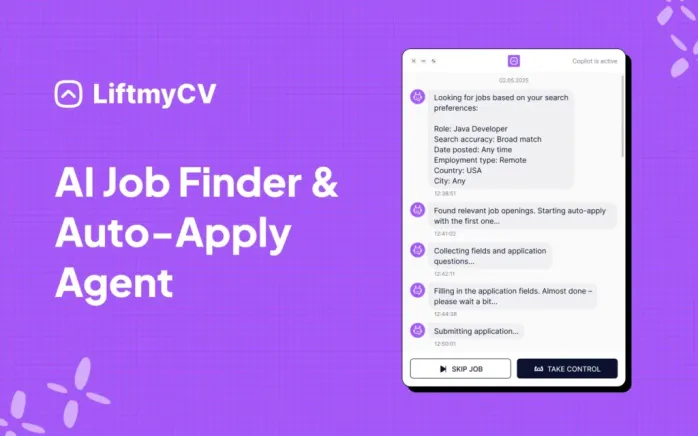
For recent graduates, this can reduce the time spent copying details into different forms and help maintain a steady volume of applications without constant manual effort. When combined with your own checks for fit and quality, it can keep your pipeline active while you study, work part-time, or build projects.
Resume generator tailored per job
LiftmyCV uses AI and large language models to adapt your resume or profile to each job description. These systems can highlight the most relevant skills and experiences for a specific posting and rephrase bullet points so they align with employer language while staying truthful.
For graduates, a contextual AI resume generator per job can make it easier to position coursework, internships, or volunteer work in a way that fits the role you are targeting. It does not replace your input, but it can speed up the process of creating targeted, ATS-friendly versions instead of relying on one static document.
Reducing manual application burnout
One of the biggest emotional drains for graduates is the cycle of repetitive applications with little feedback. AI-based auto-apply features, like those in LiftmyCV and similar tools, help by automating repetitive fields, tracking where you applied, and keeping your applications organized.
This structure can reduce decision fatigue and help you stick to a consistent application routine, which studies and career surveys link to better outcomes over time. The key is to balance automation with occasional manual review so you stay in control of where your name is being sent and how you are represented.
Try LiftmyCV today to automate your job search, tailor each resume to the role, and start landing more interviews with less effort.
As one AI job search columnist put it, “The most effective use of AI for job seekers is offloading repetitive tasks so you can invest your limited energy into relationships and real skill-building.” – paraphrased from Dan Zaitsev’s discussion of AI tools for job search.
AI Job Tools Overview for Graduates
These tools are most effective when combined with your own strategy, such as targeting certain roles, building a simple portfolio, and using networking to unlock opportunities that never make it to public job boards.
Common Mistakes Recent Graduates Make When Job Searching
Even strong graduates fall into patterns that slow their search without realizing it. Seeing these clearly can help you adjust faster and avoid months of silent applications.
Mass applying
Sending the same resume to dozens of roles a day feels productive, but usually leads to low response rates. Recruiters report that untailored applications are easy to spot and are often filtered out early, especially when ATS systems look for close matches to the job description.
A smaller number of well-targeted, well-researched applications almost always performs better than huge volumes of generic ones. Tools that help with auto-filling can support this strategy, as long as you still control which roles you pursue and how you present your experience.
Ignoring ATS
Many mid-size and larger companies use applicant tracking systems to screen resumes before a human ever reads them. If your resume uses unusual formatting, images, or does not reflect key skills from the job description, it may be rejected automatically.
Career experts advise using clean layouts, standard headings, and language that mirrors the genuine requirements of the role you are applying for. This does not mean stuffing keywords, but rather describing your real experience in terms that line up with the job description.
Waiting too long after graduation
Delaying your search for several months after graduation can narrow your options, especially for structured graduate programs that recruit on fixed cycles. Data from career reports note that timing plays a big role in outcomes, because many entry-level roles are filled in waves shortly after graduation seasons.
If you have already waited, the best move is to start small but consistently: a handful of targeted applications each week, outreach to alumni, and one tangible project you can add to your portfolio. Momentum matters more than trying to “catch up” all at once.
Not tracking applications
Without a simple tracking system, it is easy to lose sight of where you applied, miss follow-ups, or accidentally submit duplicate applications. This can hurt your chances, especially when employers expect candidates to remember earlier conversations or screening steps.
Even a basic spreadsheet or the tracking functions of AI job search tools, like LiftmyCV can keep your search organized. Tracking also creates data: after a few weeks, you can see which types of roles or industries are producing interviews and adjust your strategy accordingly.


FAQ
Why do so many recent graduates struggle to find their first job?
Because the market is crowded and most graduates apply in the same way. Recruiters see hundreds of similar CVs, often with identical wording and no clear signal of real skills. The issue is rarely effort, it’s positioning.
When should graduates realistically start looking for a job?
Earlier than most people think. The strongest candidates usually start preparing three to six months before graduation. Waiting until after graduation often means competing with a larger pool for fewer truly entry-level roles.
Where should recent graduates focus their job search first?
Job boards are useful, but they shouldn’t be the only channel. Company career pages, graduate programs, referrals through alumni, and LinkedIn outreach tend to produce better results than mass applying through one platform.
How can graduates stand out without formal work experience?
Experience doesn’t have to mean a full-time job. Projects, internships, coursework, volunteering, and even self-initiated work can be strong signals if they clearly show skills, tools used, and outcomes. Recruiters care more about what you can do than where you did it.
Is it necessary to tailor a resume for every application?
Yes. Generic resumes usually fail at the first screening stage. Small changes that reflect the job description, required skills, and role focus can significantly improve ATS pass rates and recruiter response.
Can AI tools actually help recent graduates get interviews faster?
They can help with consistency and speed. AI tools like LiftmyCV are useful for tailoring resumes per role, tracking applications, and avoiding common mistakes. They don’t replace strategy, but they reduce the manual work that causes many graduates to burn out early.
Read Next

How to Get Into Graphic Design and Land Your First Design Job
Choose a design lane, build a three-project portfolio with case studies, and apply while 9,064 graphic design roles are open.
How to Find a Job: The Complete Step-by-Step Guide
How to find a job step by step: where to search, how to get past the ATS, the best way to apply faster, and how to automate your job search with LiftmyCV.

How to Become a Copywriter, From First Sample to First Paid Job
Pick a copy lane, build four samples that prove it, and apply while 1,944 copywriter roles sit open. Pay data and timelines included.