
Top 10 Interview Questions & Best Answer Tips by Experts
Ace your next interview with expert-backed answers to the top 10 interview questions. Get proven tips, real examples, and winning strategies for 2025.
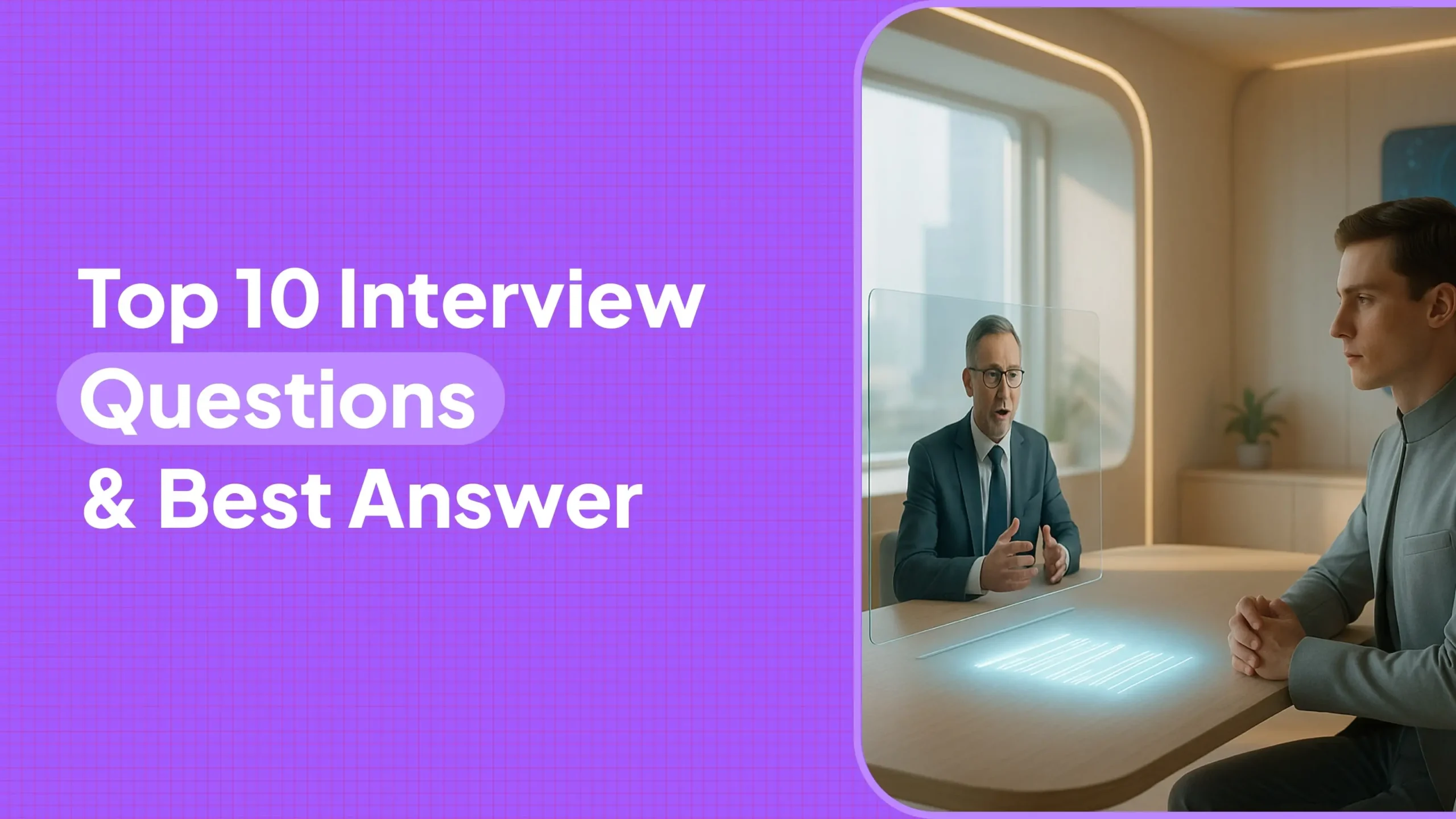
every pause, and every example can determine your next career step. But here’s the good news: with the right preparation, you can go in feeling ready, calm, and even excited to share your story.
Today’s interviews are more competitive than ever. Companies get hundreds of applications for each role, so even before you meet a human, your resume may be screened by Applicant Tracking Systems (ATS). When you do get to the interview stage, you’ll face a mix of behavioral, situational, and technical questions – sometimes with multiple rounds or virtual interviews in the mix. The best way to stand out? Prepare practical stories, structure your answers with a clear method, and show why you’re the right fit for the job.
What you’ll find in this guide:
- The 10 most common interview questions (and why interviewers ask them)
- Best-practice answer structures, like the STAR method, to organize your stories
- Real, tailored example answers for entry-level, mid-level, and executive candidates
- Expert-backed interview tips drawn from trusted sources like Indeed, Robert Half, and The Muse
- A hands-on checklist for virtual interviews and recruiter screens
Expert says:
According to the team at Indeed, “The strongest candidates practice their answers out loud, prepare real-world examples, and do their homework on the company – so they can tailor responses on the spot.” (source)
Why it matters:
Preparation isn’t just about calming your nerves – it’s about learning how to tell your story in a way that’s clear, relevant, and memorable to interviewers (both human and automated).
Understanding Modern Interview Formats – Behavioral, Situational, Technical, and Screening
Before you dive into practicing answers, you need to know what kind of interview you’re preparing for. Today’s companies rarely rely on a single format. Most hiring processes combine several approaches to get a full picture of who you are and how you think – especially for tech, finance, and marketing roles.
1. Behavioral Interviews
These focus on your real past experiences. Recruiters and hiring managers use behavioral questions to predict how you’ll act on the job based on how you’ve handled situations before. According to Indeed’s common interview questions guide, you’ll hear prompts like:
- “Tell me about a time you faced a challenge at work.”
- “Describe a situation where you had to work as part of a team.”
Best way to answer:
Use the STAR method – Situation, Task, Action, Result. This gives your stories structure and makes your examples clear and memorable.
2. Situational Interviews
Instead of asking about the past, situational questions ask you to imagine how you’d handle a hypothetical scenario:
- “What would you do if you were assigned multiple projects with tight deadlines?”
- “How would you deal with a difficult stakeholder?”
The goal is to see your problem-solving, judgment, and flexibility in action. Break down your answer step-by-step: show that you’d analyze the situation, weigh options, communicate, and take responsibility.
3. Technical Interviews
Especially in tech and finance, technical interviews are used to test your actual skills. You might get coding challenges, data analysis tasks, case studies, or be asked to solve a business problem live.
According to Indeed, the key is to “think out loud” – interviewers care about your logic and approach, not just the right answer.
4. Screening Interviews
These are usually first-round calls or virtual interviews with recruiters or HR. They’ll ask about your resume, motivation, availability, and salary expectations. Some companies use AI-powered or one-way video screening – so concise, direct answers matter.
Practice a brief “elevator pitch” – your 30-second summary of who you are, what you bring, and what you want next.
Checklist:
- Know which format you’re facing
- Prepare at least two STAR stories for behavioral rounds
- Be ready for a technical task or case study, even if it’s not mentioned in the job ad
- Practice your pitch for screening calls
The 10 Most Common Interview Questions – What They Reveal and How to Answer

Every recruiter has a favorite question, but a core set appears in nearly every interview. Understanding why these are asked – and what a great answer sounds like – will help you prepare for any role, in any industry.
1. Tell me about yourself
Why they ask: To see how you present your background and what you think matters.
How to answer: Share a short career story, highlight relevant experience, and connect it to the job you want.
2. Why do you want to work here?
Why they ask: They want proof you care about this job – not just any job.
How to answer: Reference company values, recent projects, or industry reputation.
3. What are your greatest strengths?
Why they ask: To see what you bring to the table – and whether you’re self-aware.
How to answer: Choose a strength that fits the role, and give a real example.
4. What is your greatest weakness?
Why they ask: To test honesty and self-awareness.
How to answer: Pick a real weakness, explain how you’re improving, and keep it positive.
5. Tell me about a time you faced a challenge at work.
Why they ask: To judge your resilience and problem-solving skills.
How to answer: Use the STAR method (Situation, Task, Action, Result).
6. Describe a situation where you worked on a team.
Why they ask: Collaboration is key in nearly every job.
How to answer: Share a STAR story about teamwork, your role, and the result.
7. How do you prioritize tasks or manage deadlines?
Why they ask: To see if you’re organized and proactive.
How to answer: Name a system or tool, and share a concrete example.
8. Tell me about a failure or mistake you made.
Why they ask: Accountability and growth are critical.
How to answer: Be honest, show what you learned, and how you changed.
9. How do you handle feedback or criticism?
Why they ask: Companies need coachable, growth-oriented employees.
How to answer: Share a story about receiving feedback and improving.
10. Do you have any questions for us?
Why they ask: This is your chance to show engagement and curiosity.
How to answer: Ask about team culture, success metrics, or company goals.
The STAR Method – How to Structure Memorable Answers
Every great interview answer tells a story, and the STAR method is the gold standard for keeping stories concise, relevant, and impactful. Top recruiters, including those quoted in Indeed’s interview resources, rely on STAR because it helps candidates connect their experience to the job at hand.
What is STAR?
- Situation: What was the context? Set the stage briefly.
- Task: What goal or challenge were you facing?
- Action: What did you actually do? Highlight your personal contribution.
- Result: What happened? Quantify outcomes if you can.
Why STAR Works
- Makes your answers clear, organized, and focused.
- Shows interviewers you can reflect and communicate with impact.
- Helps you avoid rambling or giving “all action, no results” answers.
Sample STAR Answer – Entry-Level (Tech)
Question: Tell me about a time you overcame a challenge.
Situation: In my university group project, two team members dropped out a week before our deadline.
Task: I was responsible for integrating all code modules and ensuring we had a working demo.
Action: I re-allocated tasks, wrote key missing functions, and scheduled nightly check-ins to track progress.
Result: We delivered the project on time and received the top grade in class.
Sample STAR Answer – Mid-Level (Finance)
Question: Describe a situation where you managed multiple deadlines.
Situation: At my previous firm, I was given two urgent portfolio reviews days before the end of quarter.
Task: I needed to complete both accurately, without delaying client reporting.
Action: I used a priority matrix, blocked time for each client, and communicated progress with the team.
Result: Both reviews were submitted ahead of deadline, and our team received a client commendation.
Common STAR Mistakes to Avoid
- Skipping “Result”: Always close with a concrete outcome.
- Being too vague: “I helped out” isn’t enough – share specifics.
- Not linking to the job: After your story, connect your skills to the role you want.
Expert says:
Career coaches at Indeed recommend “writing out several STAR stories before the interview, practicing them aloud, and tailoring them for the job you want.” (source)
Have at least three STAR stories prepared: one for success, one for overcoming a setback, and one about teamwork or leadership.
Sample Answers for Top Interview Questions – Entry-Level, Experienced, and Manager
Great interview answers are both authentic and tailored to your experience level. Here’s how real candidates can use the STAR method to stand out for tech, finance, and marketing roles.
1. Tell me about yourself
Entry-Level (Tech):
“I graduated with a degree in computer science last year. During my studies, I interned at a SaaS startup, where I helped optimize a customer support chatbot. I learned how to work with cross-functional teams and am excited to bring my coding and collaboration skills to your company.”
Experienced (Finance):
“I’ve spent seven years in financial analysis, focusing on data-driven portfolio management. At my last firm, I led a team of three and was responsible for process improvements that cut reporting time by 25%. I’m now looking to drive results at a larger scale.”
2. Why do you want to work here?
Entry-Level (Marketing):
“I admire your company’s data-first approach to branding and your award-winning sustainability campaigns. I’m eager to apply my content and analytics experience to support your next product launch.”
3. What is your greatest strength?
Mid-Level (Tech):
“My biggest strength is creative problem-solving. When my team faced a critical server outage just before launch, I coordinated a rapid fix by delegating diagnostics, communicating transparently with stakeholders, and delivering a solution ahead of schedule.”
4. What is your greatest weakness?
Manager:
“I used to micromanage, wanting to double-check every deliverable myself. Over time, I’ve learned to trust my team more, set clearer expectations, and empower others. Now, my teams move faster – and morale is higher.”
5. Tell me about a time you faced a challenge at work
Entry-Level (Finance):
“During my internship, our team had to finish a client audit just as several members left on vacation.
Situation: Audit deadline in jeopardy.
Task: I volunteered for extra data review.
Action: I learned the workflow, checked numbers, and worked late to keep us on track.
Result: We finished on time, and my manager praised my flexibility.”
6. Describe a situation where you worked on a team
Mid-Level (Marketing):
“Our agency had to launch a campaign in half the normal time.
Situation: Tight deadline and new client.
Task: I coordinated content, analytics, and design teams.
Action: Daily check-ins, milestone tracking, quick feedback loops.
Result: Campaign beat engagement targets by 25%.”
7. Tell me about a failure or mistake you made
Manager (Tech):
“In my first lead role, I underestimated how long a redesign would take, missing a deadline and frustrating the client.
Situation: Missed delivery date.
Task: Restore client trust and prevent repeats.
Action: Apologized, created new progress reports, and built in more review time.
Result: The client renewed and cited our improved transparency.”
Comparison Table: STAR Answers by Role
| Question | Entry-Level | Mid-Level | Manager |
| Overcoming Challenge | Volunteered for new tasks, met deadline | Solved process issue, improved metrics | Navigated crisis, rallied team |
| Teamwork | Supported peers in group project | Led cross-team campaign, shared feedback | Built/mentored high-performing teams |
| Failure/Mistake | Missed details, learned new quality checks | Miscommunicated, improved collaboration | Underestimated scope, rebuilt stakeholder trust |
Common pitfall:
Avoid generic stories (“I just worked hard”). Instead, use details – what you did, who benefited, what changed.
How to Ask Questions That Impress Recruiters – With Winning Examples
Your interview isn’t over when the questions stop. What you ask the employer reveals just as much about your fit, your priorities, and your preparation as anything else you say. Recruiters often note that memorable candidates are the ones who show curiosity, strategic thinking, and a genuine interest in the team and company (Indeed Interview Tips).
Why Your Questions Matter
- Demonstrates Research: Smart questions show you know the company’s values, recent projects, and challenges.
- Shows Engagement: Candidates who ask about culture, success metrics, and team structure are seen as invested in long-term growth.
- Opens Dialogue: Well-chosen questions encourage a two-way conversation and help you stand out from those who just “answer and leave.”
Winning Questions to Ask at the End of Your Interview
1. “How do you define success for this role in the first six months?”
This signals you’re results-focused and eager to make an impact.
2. “Can you describe the team’s working style and collaboration methods?”
Shows you value teamwork and want to thrive in their environment.
3. “What are the company’s biggest opportunities and challenges this year?”
Reveals your interest in contributing to business goals – not just doing the minimum.
4. “What professional development resources do you provide for employees?”
Highlights your desire to learn, upskill, and grow with the company.
5. “What’s your favorite part about working here?”
Personal, memorable, and offers a window into the culture.
What to Avoid
- Don’t ask about salary, benefits, or vacation time until the employer raises them.
- Avoid questions with answers easily found on the company website or in the job description.
- Don’t skip your turn – if you say “No, I’m good,” you risk looking unprepared.
Expert advice:
Indeed’s career experts suggest, “Candidates who ask thoughtful questions leave a strong impression and often receive higher marks for engagement and preparation.”
How LiftmyCV’s AI Agent Helps Job Seekers Land More Interviews
Standing out in today’s job market means being smart, fast, and personal with every application. That’s exactly where LiftmyCV’s AI-powered agent gives you a real edge.
Why job seekers love LiftmyCV:
- Intelligent Job Matching: The AI agent reviews your skills, experience, and preferences, then suggests roles that truly fit – no more wasting hours on generic job boards.
- AI Autofill: LiftmyCV uses a smart AI autofill feature to complete job applications and generates customized cover letters for each position.
- Autopilot vs. Copilot Modes: Want to save time? Activate “Autopilot” to apply to quality jobs automatically, or use “Copilot” to review and customize every application before it’s sent.
- Auto-Apply History: See exactly where you’ve applied, track responses, and manage follow-ups – all in a single, easy dashboard.
- Designed for Human Results, Not Spam: Unlike mass-applying bots, LiftmyCV personalizes each submission. Users consistently report more interview invites and faster recruiter replies.
- ATS Resume AI Generator: Our user-friendly AI generator helps job seekers quickly convert their profiles into ATS-optimized resumes in just minutes.
- Cover Letter per Job Generator: LiftmyCV’s AI agent creates a tailored cover letter for every job application, taking into account the job description, requirements, and more.
Real user feedback:
“Before LiftmyCV, my applications felt like they disappeared into a black hole. Now, recruiters actually respond – and I landed two interviews within weeks.” – Amira K., Data Analyst, Berlin
Get started free – no subscription required. Join thousands of job seekers who are landing interviews faster and with less stress. Try LiftmyCV’s AI agent today.
Final Thoughts: Winning Interviews in 2025 – Preparation, Storytelling, and Authenticity
As you reach the end of this comprehensive guide, one thing should be clear: job interviews aren’t a mystery or a minefield – they’re a skill you can master. Every recruiter, career coach, and hiring manager interviewed for trusted resources like Indeed agrees: candidates who prepare real examples, structure their answers, and show honest curiosity will always stand out – regardless of industry or role.
Key Takeaways
- Preparation Is Your Edge: Know the most common questions and rehearse your answers, but stay flexible. Practice aloud, get feedback from a friend, and review your resume so you can quickly connect past experience to new challenges.
- STAR Stories Win Interviews: Recruiters value candidates who use the STAR method to communicate results and lessons learned – not just what they did, but why it mattered. Craft 3-4 stories that showcase your strengths, how you overcome setbacks, and what you’ve learned from mistakes.
- Engage With the Interviewer: Smart, tailored questions aren’t just a formality – they’re a sign of genuine interest. Use your turn to ask about the company’s goals, culture, or challenges. It shows you’re invested in more than a paycheck.
- Honesty and Self-Awareness Beat “Perfect” Answers: As The Muse and Robert Half emphasize, it’s better to admit a real weakness and describe how you’re improving than to pretend you have none. Authenticity builds trust.
Why This Matters in the Age of AI and Remote Hiring
With more companies using ATS, AI-powered screening, and remote interviews, your ability to stand out – on paper and in person – matters more than ever. That doesn’t mean “gaming the system,” but rather, combining good tools with good stories and human connection.
From Preparation to Offers: Your Next Steps
- Use the sample answers and STAR templates in this guide to create your own stories.
- Research each company, personalize your responses, and avoid clichés.
- Practice with a friend or mentor, or record yourself to spot weak points.
- Track your progress and always follow up with a thank-you note.
Expert reminder:
“Prepared candidates, who reflect on their stories and ask great questions, leave a lasting impression – every time.” (Indeed Interview Tips)
BONUS VIDEO: Best Responses to Common Interview Questions


FAQ
What’s the best way to prepare for common interview questions?
Study the most frequently asked questions, write out your answers using the STAR method (Situation, Task, Action, Result), and practice aloud. As Robert Half and Indeed both note, structured practice boosts confidence and helps you sound natural, not rehearsed.
Should I memorize my answers or improvise during interviews?
Memorizing word-for-word can make you sound robotic. Instead, focus on practicing your key points and STAR stories so you can adapt your answers to any question, as advised by The Muse and HBR.
How do I answer the “greatest weakness” question without hurting my chances?
Choose a real but non-fatal weakness and explain how you’re working to improve it. Both The Muse and HBR stress that honesty and a growth mindset are what recruiters want – not “fake” weaknesses like “I work too hard.”
What types of questions should I ask at the end of my interview?
Ask about success metrics, team culture, current challenges, or professional growth opportunities. Experts at Indeed and Robert Half recommend having 2-3 thoughtful questions prepared that go beyond pay or vacation.
Can using AI tools really help me land more interviews?
Yes – AI-powered platforms like LiftmyCV can help you generate tailored resumes and cover letters, track your applications, and even identify the best-fit roles. Just remember to review and personalize each application, as recruiters still value the human touch.
Read Next
Follow-Up Emails After Interviews | Templates + AI Writing Tips
Discover how to write follow-up emails after interviews and applications using AI tools. Get templates and tips to improve your chances.
How to Use ChatGPT to Prepare for Job Interviews (2025 Guide)
Learn how to use ChatGPT to prepare for interviews in 2025. Run mock interviews, get feedback, and master the STAR method with AI prompts.
How to Answer Interview Questions Like a Pro — Expert Tips & Examples
Learn how to answer common interview questions with expert tips, examples, and proven methods to boost your confidence and get hired faster.